Make a few changes in your driving habits to save money

Friday, August 27, 2010

From Madison Gas & Electric:

A few changes in your driving habits could save you money and gasoline. Hypermilers say it's easy... and anyone can do it.You don't have to drive an electric car or hybrid to drive more sustainably. In this story, we hit the road with an expert hypermiler to learn what it takes to go the extra
mile.

Utilities building dozens of old-style coal plants

Thursday, August 26, 2010

From an Associated Press article by Matthew Brown published in The Washington Post:

WYODAK, Wyo. -- Utilities across the country are building dozens of old-style coal plants that will cement the industry's standing as the largest industrial source of climate-changing gases for years to come.

An Associated Press examination of U.S. Department of Energy records and information provided by utilities and trade groups shows that more than 30 traditional coal plants have been built since 2008 or are under construction.

The construction wave stretches from Arizona to Illinois and South Carolina to Washington, and comes despite growing public wariness over the high environmental and social costs of fossil fuels, demonstrated by tragic mine disasters in West Virginia, the Gulf oil spill and wars in the Middle East.

The expansion, the industry's largest in two decades, represents an acknowledgment that highly touted "clean coal" technology is still a long ways from becoming a reality and underscores a renewed confidence among utilities that proposals to regulate carbon emissions will fail. The Senate last month scrapped the leading bill to curb carbon emissions following opposition from Republicans and coal-state Democrats.

"Building a coal-fired power plant today is betting that we are not going to put a serious financial cost on emitting carbon dioxide," said Severin Borenstein, director of the Energy Institute at the University of California-Berkeley. "That may be true, but unless most of the scientists are way off the mark, that's pretty bad public policy."

Federal officials have long struggled to balance coal's hidden costs against its more conspicuous role in providing half the nation's electricity.

Hoping for a technological solution, the Obama administration devoted $3.4 billion in stimulus spending to foster "clean-coal" plants that can capture and store greenhouse gases. Yet new investments in traditional coal plants total at least 10 times that amount - more than $35 billion.

No county rail tax referendum this fall

Wednesday, August 25, 2010

From an article by Matthew DeFour in the Wisconsin State Journal:

The last chance for a countywide commuter rail sales tax referendum in November died in committee Tuesday despite calls from rail opponents to let the public be heard.

About 30 people spoke at the County Board’s Public Works and Transportation Committee meeting, all of them supporting a proposal to ask voters whether they supported a half-cent sales tax for commuter rail between Middleton and the town of Burke.

Expressing a common criticism, Colleen Curtin, a single mother from Madison’s West Side, said she wouldn’t take the commuter train to work in McFarland because it would be too difficult to pick up her child from daycare. She said it felt like the $250 million commuter rail proposal was being “shoved down our throats.”

“We feel hopeless, that we have no voice,” Curtin said. “And you guys are demonstrating that even more by pushing off this referendum.”

The committee’s 2-2 vote prevented the resolution from advancing to the County Board. Committee chairman Sup. Matt Veldran, of Madison, said the Regional Transit Authority is working on a transit plan that must be completed before a vote can be taken.

“I fully believe there will be a vote,” Veldran said. “I understand the frustration, but I believe the RTA is what I approved and I would like them to come up with a complete question.”

State speeds train spending

Tuesday, August 24, 2010

From an article by Jason Stein and Patrick Marleyin the Milwaukee Journal Sentinel:

$300 million in contracts projected this year, far above $50 million announced earlier

Madison — The state is steaming ahead with establishing a federal high-speed rail line, projecting it will commit $300 million this year - far more than the roughly $50 million in spending previously announced.

The project's price tag isn't changing. Instead, Gov. Jim Doyle's administration is hustling to move forward with the planned passenger rail line between Milwaukee and Madison, which Republicans say is an attempt to make it harder for the next governor to cancel.

GOP gubernatorial candidates Scott Walker and Mark Neumann have said they would stop the train line regardless of how much the state spends in the next few months because of concerns about taxpayer subsidies to operate the system. Calling the accelerated spending a bluff, Walker said Monday that a new governor could get the state out of contracts entered into by the Doyle administration.

"By the end of the year it is anticipated we will have expended $300 million," state Transportation Secretary Frank Busalacchi said Sunday in an interview on "UpFront with Mike Gousha."

Busalacchi aide Cari Anne Renlund clarified Monday that the state will have spent or entered into contracts for roughly that amount by the end of the year but won't necessarily have spent that much. The construction of the $810 million line is being paid for by the federal government, but the state could be on the hook for both the spending and possibly the contracts signed on it so far if the state doesn't finish the construction.

Walker, the Milwaukee County executive, said he did not believe Busalacchi's new figure of $300 million. He said the state may sign contracts worth $100 million or so before the end of the year, but he believes as governor he would be able to break those contracts and pay only for the work that has actually been performed.

"I think this is all just part of the political rhetoric to try to intimidate people into thinking this is a done deal, and I just don't think people are going to buy it," Walker said. "I think in the end this is more a bluff on their part."

The route, which is supported by Democratic gubernatorial candidate and Milwaukee Mayor Tom Barrett and previously had the backing of then GOP Gov. Tommy Thompson, would be an extension of Amtrak's existing Milwaukee-to-Chicago Hiawatha line and eventually could be extended to the Twin Cities. It would start service in 2013 at a top speed of 79 mph, increasing to 110 mph by the end of 2015.

Wisconsin high-speed rail - Madison rail station discussion, Aug. 31

Monday, August 23, 2010

Tuesday, August 31, 2010
4:30 p.m. – 7:30 p.m.
Wisconsin Department of Administration
101 E. Wilson Street
Open house meeting – stop by anytime!

This is an opportunity for the public to provide input on the station design and to learn about station preliminary cost estimates, conceptual site layout and platform layouts.

For more information visit www.wisconsinrail.gov

Community workshops for high-speed rail project scheduled in Sun Prairie and Waterloo

Friday, August 20, 2010

From a news release issued by the Wisconsin Department of Transportation:

The Wisconsin Department of Transportation (WisDOT) is announcing two community workshops to discuss the design process for the High-Speed Intercity Passenger Rail project. The workshops are scheduled from 4:30 to 7:30 p.m. on August 25, 2010 and August 30, 2010. The August 25 workshop will be held at the Sun Prairie Municipal Building, 300 E. Main Street, Sun Prairie, WI. The August 30 workshop will be held at the Waterloo High School at 865 N. Monroe Street, Waterloo, WI.

At the workshop WisDOT and consultant staff will be available to discuss design activities in the Milwaukee-Madison rail corridor. Staff is also interested in hearing from the community on issues of concern to them as design continues to get underway. The team preparing the planning and environmental studies for rail stations in the corridor will also be on hand to answer questions about the station development process.

The public is encouraged to attend the meeting, provide input and ask questions concerning this project. Maps showing project corridor and potential station sites will be on display.

If you are unable to attend the meeting, or would like more information, contact Alyssa Macy at (414) 550-9407. Written comments regarding the project can be mailed to Alyssa Macy, Wisconsin Department of Transportation, High-Speed Passenger Rail Program Management Team, 433 W. St. Paul Avenue, Suite 300, Milwaukee, WI 53203-3007. To request an interpreter for people who are deaf or hard of hearing, please call 711, the Wisconsin Telecommunication Relay System, at least three working days prior to the meeting. Ask the communication assistant to contact Alyssa Macy of the Wisconsin Department of Transportation at (414) 550-9407.

For more information, contact:
Alyssa Macy, High Speed Rail Program
(414) 550-9407, WisconsinRail@dot.wi.gov

Doyle announces Interstate 39-90 expansion

Thursday, August 19, 2010

From an article by Barry Adams in the Wisconsin State Journal:

A plan to spend an estimated $1 billion to expand Interstate 39-90 between the Illinois border and Madison is moving forward.

Gov. Jim Doyle has announced that he will convene the Transportation Projects Commission this fall to review the proposed project that would replace existing pavement along the 45-mile corridor, add a third lane in each direction, replace two bridges over the Rock River and reconstruct 11 interchanges.

Economic development leaders in Rock County have pushed for the project because they say it would make the highway safer, the area more attractive for business development, and aid the state's tourism industry, which draws many of its visitors from south of the border.

"The single most important thing government can do is set the table for economic growth, and that includes infrastructure improvements," said John Beckord, president of Forward Janesville. "We look forward to the project being enumerated and scheduled for construction."

The Department of Transportation is required to submit its proposal to the TPC by Sept. 15 with the TPC meeting in December to make a recommendation to the governor or governor-elect, the Legislature and Joint Committee on Finance.

Perhaps sprawl cost us after all

Wednesday, August 18, 2010

From a commentary by Mike Ivey in The Capital Times:

Old Madison fave Richard Florida is back with a good piece in the New Republic titled Roadmap to a High Speed Recovery.

There, Florida opines that America needs to stop subsidizing what he calls the "auto-housing-suburban complex." Think McMansion, Kwik-Oil, Strip Mall Takeout and the rest of it.

Florida -- who gave Madison raves for its gays, music and urban tech scene in his 2002 "Rise of the Creative Class" -- wants to end government subsidy of the sprawl housing industry.

That means eliminating the mortgage interest tax deduction along with federal backing of the secondary mortgage market.

"Federal policy needs to encourage less home ownership and a greater density of development, along with the construction of smaller and more low-energy houses," he says.

That's not just green -- but it frees up capital to invest in technology development for a future economy.

Florida's reasoning is that homeownership worked well for a nation whose workers had secure, long-term careers like in the days before NAFTA and 401(k)s. But now, he says, being tied to a mortgage impedes the flexibility of a labor market that requires people to move around and change jobs several times.

Instead of new housing, Florida says the government should be promoting things like high-speed rail. He says modern rail can help create inter-connected mega-regions, like the Boston-Washington corridor and the Char-lanta region (Atlanta, Charlotte, and Raleigh Durham).

GreenMax Home completed in Stoughton

Friday, August 13, 2010


John and Rebecca Scheller built one of the region's first net zero energy homes that can be reasonably and affordably replicated in a cold-climate region.

Mass transit just a matter of time

Wednesday, August 11, 2010

From a column by Dave Zweifel in The Capital Times:

The times they keep a-changin’.

For the first time ever, the venerable Chicago Tribune/WGN poll shows that a majority of residents in the suburbs have joined their city brethren in believing that expanding mass transit is preferable to spending more on roads and highways.

For 30 years now, the poll has been asking the question: “Which should have greater priority, improving/adding to expressways and tollways, or to the public transit system?”

This year, 76 percent of city residents, most of whom forgo cars to ride commuter rail or the buses, answered “public transportation,” while 15 percent picked roads. (The remainder weren’t sure.)

What surprised the pollsters this year, though, is that suburban dwellers, who have typically relied on cars to get back and forth to work, also said they favored investing in public transportation over roads, although by a closer margin, 52 percent to 32 percent. In the past, suburbanites have strenuously objected to having their tax dollars go for improving what was once thought to be an expensive perk only for city residents.

Many of the respondents who would put public transit ahead of highways pointed to the growing stress that comes from highway congestion and high gasoline prices. Some identified the impact on the environment and health. The poll indicated that more and more people are concerned that sitting in traffic breathing exhaust fumes isn’t conducive to one’s well-being. Some 17 percent of the people polled said they had switched this past year from driving to using public transit.

According to the Tribune, the director of a Chicagoland civic organization called the results “phenomenal.”

“People are seeing that a car-oriented culture is limiting economic development and quality of life in the region,” said Frank Beal, executive director of Chicago Metropolis 2020.

County Clerk Bob Ohlsen: Why all-RTA vote nearly impossible this fall

Tuesday, August 10, 2010

From a column by Dane Co. Clerk Bob Ohlsen in The Capital Times:

There has been a great deal of talk, including in The Capital Times, about why the RTA referendum question will more than likely not be on the November ballot, mostly pointing at me, the county clerk, for saying it was nearly impossible to do so. Here is my response:

Only the RTA board has the authority to call for a binding referendum at a regularly scheduled election. Two conversations with the chair of the RTA board, one in February and one in July, indicated that the question would probably not be ready for the November election. With the difficulty in making sure only the people within the RTA boundaries could vote, work had been started to set up the voting boundaries. For the cities, towns and villages entirely within the RTA district, that wasn’t a problem -- everyone could vote on the issue. The concern lay in the municipalities that are only partially within the district.

Meetings were held with each of the local clerks, going over maps to identify those addresses that are in the district. Because the RTA boundaries do not follow political boundaries, the district combos for the voters (combinations of the political districts: Senate/Assembly, county supervisory, school, utility districts, wards) would be affected, along with the address ranges (addresses on each street within the district combos) set up in the Statewide Voter Registration System (SVRS). Many of the current address ranges would have to be changed, taking voters out of one range and putting them in another.

When the SVRS system was created, RTA districts were not included, so there were changes to the system that would be necessary. Because it is essential for election inspectors to correctly identify the voters who are allowed to vote on the referendum, it was felt that a different set of numbers should appear on the poll list. By adding a dash and an extra number, the voter’s district combo would appear differently, and at first glance, the inspector would be absolutely sure the voter was getting the correct ballot. The SVRS staff was skeptical whether this change would work in the system. After some preliminary testing, however, it was determined that it was possible and they began to write scripts for the system and do the extensive testing that was necessary. The hope was to get it done by July 1, giving the clerk’s staff time to verify the information and make all the necessary changes (a time-consuming, complex process) in the system, along with the SVRS staff, to be ready just in case a November referendum was called.

Unfortunately, this didn’t happen. The go-ahead has yet to be received. The July 1 date would have made it difficult to get the necessary work done, but at this late date, it is truly nearly impossible.

UW-Madison's Charter Street coal plant embarks on its transition to cleaner fuels

Friday, August 06, 2010

From an article by Ron Seely in the Wisconsin State Journal:

It's not easy going green.

Just ask John Harrod Jr., who is helping guide the $250 million green makeover of UW-Madison's Charter Street Heating Plant.

The coal-burning plant will be converted so that it burns natural gas and cleaner, farm-grown fuels such as switchgrass. The changeover that has won praise from the plant's many critics, including the Sierra Club, which sued the university for violating the Clean Air Act. Gone will be the giant, dust-generating pile of coal that has become a symbol of the plant and its grimy history.

But Harrod, director of the UW-Madison Physical Plant, said getting rid of that coal pile and moving to cleaner biofuels has brought its own set of problems to solve — accommodating longer and more frequent trains, for example, or expanding the plant's footprint in its already squeezed urban setting, or figuring out new air standards for burning biofuels when even environmental regulators aren't quite sure what those final standards will be.

Those issues and others will be up for discussion Wednesday when UW-Madison hosts a hearing on the final version of the environmental impact statement for the project. The hearing is scheduled for 5:30 p.m. in Room 1106 of the Mechanical Engineering Building, 1513 University Ave.

Cow Power project breaks ground

Thursday, August 05, 2010


From a news release issued by Governor Doyle:

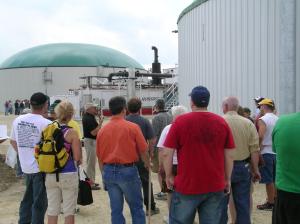
WAUNAKEE – Governor Jim Doyle today broke ground on a $12 million community digester project that will help clean Dane County air and lakes, and generate enough clean energy to power 2,500 homes. Governor Doyle joined Dane County Executive Kathleen Falk for the groundbreaking of the “Cow Power” project at the Ripp’s Dairy Valley farm in Waunakee.

“The Dane County Digester demonstrates the best of our past and future in agriculture – putting to work three local farms to power our homes and clean our environment,” Governor Doyle said.

"With the turn of these forks today, we begin new, exciting work to clean up our lakes and turn a big problem into a valuable commodity," County Executive Kathleen Falk said. "Thanks to the help of the Governor, the courage and willingness of these farmers to be good stewards of the lakes and lands we love, and the ingenuity of Clear Horizons, we're pioneering an innovative solution to generate green energy and curtail an environmental problem."


In March 2009, Governor Doyle announced his support for the project. The state is providing $3.3 million in assistance for the first of two Dane County Digesters. The community digester is the first of its kind in the state – involving three family farms: Ripp’s Dairy Valley, White Gold Dairy and Richard Endres Farm.

Construction is expected to be completed later this year. Once operational, the facility will convert manure from the farms into nearly $2 million worth of electricity per year. Electricity generated by the digester will be enough to run 2,500 Dane County homes annually.

The community digester will create construction jobs and full-time jobs to run the digester. The project will also help local farms expand their operations.

County clerk calls commuter rail tax referendums a 'huge waste' of money

Wednesday, August 04, 2010

From an article by Mathew DeFour in The Capital Times:

Opponents of Dane County commuter rail are urging municipalities to place an advisory sales tax referendum on their November ballots, but County Clerk Bob Ohlsen is warning that would be a "huge waste" of taxpayer dollars.

County Board Sup. Eileen Bruskewitz, of Waunakee, said she would urge her village board to put the question to local voters because the County Board won't likely approve a proposal she supports that would put the question to all county voters.

The recently created Regional Transit Authority has said it will hold an advisory referendum within its boundaries before imposing a half-cent sales tax for local transit. But it's unlikely the referendum will be held this November because Ohlsen said his office won't be ready to divide ballots in municipalities split by the RTA boundary.

"We need to guarantee some way that the public is going to have a chance to vote on whether a sales tax should be used on commuter rail," Bruskewitz said. "The RTA is moving forward on that assumption. Before they get too far ahead, it's time to give them a reality check."

Ohlsen sent a memo to local clerks Tuesday reminding them that his office charges a local government $300 per polling place and about five cents per ballot for local referenda. Besides school referendums, for which the clerk charges school districts, local referendums aren't held very often, he said.

"Should your municipality vote to put it on, please (be) aware that it isn't going to make one bit of difference," Ohlsen wrote. "The RTA commission will call for a referendum at some point and only the people in the RTA district will be allowed to vote."

Trains - for the future

Tuesday, August 03, 2010

From an editorial in the Milwaukee Journal Sentinel:

Scott Walker and Mark Neumann shouldn't stand in the way of a future that includes a balanced transportation network and a fast rail line connecting key cities.

Gov. Jim Doyle and U.S. Transportation Secretary Ray LaHood said last week that a fast rail project linking Chicago, Milwaukee, Madison and eventually Minneapolis can't be stopped. GOP gubernatorial candidates Scott Walker and Mark Neumann say that if elected they will stop it.

We're not sure that they can stop it; what we do know is that they shouldn't. And not just because the state would have to repay the money already spent on the line before the change of administration next year.

Rail can serve as a valuable economic development tool. We're not talking about old choo-choos here any more than expanded freeway advocates talk about the Model A; we're talking about modern rail that would provide convenient and fast service between major cities in the Midwest; service that would provide wireless Internet for busy business travelers who don't like to be tied up in traffic on highways that represent an older technology.

We have some questions about placement of the stops on the route and some about finances, especially on whether there would be federal money for operating costs, as LaHood suggested last week, and just how operating costs will be met. But in general, we believe that if it's done right, fast rail could provide a vital link for businesses and families in the Midwest and should be a strong transportation option.

Field trip to growing power in Milwaukee, Aug. 7

Monday, August 02, 2010

There’s still some room for you to come along on Saturday’s field trip to Growing Power.

What’s Growing Power? It is a non-profit organization that runs urban farms that are pretty darned amazing. Growing Power teaches about and promotes a high-yield, environmentally-sustainable system for urban agriculture developed by Will Allen, a MacArthur Foundation "genius grant" awardee. The Growing Power Vision: Inspiring communities to build sustainable food systems that are equitable and ecologically sound, creating a just world, one food-secure community at a time.

(Growing Power's Will Allen - One of Time Magazine's 100 people who most affect our world)

When: THIS Saturday, August 7. The tour starts at 2:30 p.m. We should leave Monona by 12:30-ish.

Where: Milwaukee Headquarters and Urban Farm, 5500 W. Silver Spring Drive, Milwaukee, WI 53218

Who: We have space for 15 more people in the tour.

How much: The tour is $10 per person, payable to Growing Power when we take the tour.

How to sign up: Send an email to info@tnsmonona.org, and since we'll arrange carpools, please let me know if you would like to offer to drive or need a ride. It would be helpful to also have a phone number, just in case.

How to get there: We’re carpooling. (Total Travel Estimate: 1 hour 29 minutes / 80.52 miles / Roundtrip Fuel Cost: $16.30 at 27 MPG)

In our backyard: Oil spill fouls the Kalamazoo River and threatens Lake Michigan

Friday, July 30, 2010

From an editorial by in the Milwaukee Journal Sentinel:

In a heartbreakingly familiar scene, workers are slogging into swollen waters to rescue wildlife and skim oil after a massive spill.

Only this time it's happening in Michigan, and this time the oil threatens not the Gulf of Mexico, but Lake Michigan. The oil must not be allowed into the lake. Federal and state officials should do everything they can to see to that.

The oil - about 1 million gallons of it - leaked from a pipeline owned by Enbridge Energy Partners before the breach was discovered and the pipeline shut down on Monday, federal officials say.

The oil quickly ran into the fast-moving Kalamazoo River and by late Thursday was 35 miles downstream, though still 80 miles from Lake Michigan. The oil slick so far has killed fish, coated wildlife and forced several evacuations. Part of a shift at Kellogg Co., the Battle Creek, Mich., maker of Frosted Flakes and other popular cereals, was halted because of the strong petroleum odor on Tuesday.

In what may be a sign that certain lessons still haven't been learned, a frustrated Michigan Gov. Jennifer Granholm called the response from Enbridge and the federal Environmental Protection Agency "wholly inadequate." Both EPA and Enbridge promised to do whatever it takes to clean up the spill. . . .

Oil remains the nation's lifeblood. Pipelines occasionally have problems; this pipeline was built in 1969 and may have shown signs of wear, if early reports are to be believed.

But if we've learned anything from the disaster in the Gulf of Mexico, it's that vigilance is virtue. Regulations must be tough and enforced. Companies must understand their responsibility. We urge officials to examine both the company's actions and inspection regimens.

But first, stop the spill and protect the lake.

Transportation secretary: High-speed rail is 'here to stay'

Thursday, July 29, 2010

From an article by Matthew DeFour in the Wisconsin State Journal:

WATERTOWN - Responding to critics of a passenger rail line between Madison and Milwaukee - including the leading Republican candidates for governor who are vowing to stop the project - U.S. Transportation Secretary Ray LaHood said Thursday the plan is going forward.

"High-speed rail is happening and it's here to stay," LaHood said here in announcing the second installment of an $810 million federal grant for the project.

Milwaukee County Executive Scott Walker and former U.S. Rep. Mark Neumann, who are seeking the GOP nomination for governor, have called the project a boondoggle and waste of taxpayer money.

Both have said they would halt the project if elected, despite the fact that by the time the new governor takes office, the state will have already spent between $60 million to $100 million on contracts, designs, locomotives and rail cars. That does not include money spent by the four cities along the route on train stations.

Although the federal government has said the stimulus money can only be spent on rail projects, Walker said he would push Congress to let the state use the money for roads and bridges instead.

High-voltage power line would link Madison, La Crosse

Tuesday, July 27, 2010

From a blog post by Tom Content in the Milwaukee Journal Sentinel:

American Transmission Co. announced Monday that it will seek to build a 345,000-volt power line linking Madison and La Crosse, with the cost of the project tentatively pegged at $425 million.

The Pewaukee-based power company says two years of study have shown that a 150-mile line would boost electric system reliability, savings for utilities buying power in the Midwest wholesale power market and improve access to wind power generated west of Wisconsin.

No route has yet been selected and the company will spend the next two years exploring routing alternatives in the corridor shown above. A detailed cost estimate will be available once potential routes for the line are selected, said ATC spokeswoman Anne Spaltholz.

The company will host open houses with the public and stakeholders beginning this fall to explore routing choices, she said.

The line, which has been given the name Badger Coulee Transmission Line, is expected to offset the need for about $140 million in lower-voltage upgrades in western Wisconsin communities, ATC said, citing its own studies.

ATC is a transmission-line company that is owned primarily by the local electric utilities in eastern Wisconsin.

Details about the location and cost of the line will be announced when ATC submits a formal application for the line to the state Public Service Commission in 2013. At that time, the company will submit detailed routing information about two alternatives for the commission to consider.

If approved, the line would be built by 2018.

7th Annual Kickapoo Country Fair, July 24-25, 2010

Wednesday, July 21, 2010

Now in its seventh year, the Kickapoo Country Fair is the Midwest's largest organic food and sustainability festival. In La Farge, Wisconsin, nestled among the ancient hills of the Kickapoo Valley, the fair serves up a generous helping of fun for all in celebration of family, culture, and community, all the while looking toward a healthy, sustainable future.

Held July 24-25, 2010, on the grounds of Organic Valley headquarters Kickapoo Country Fair will bring together thousands of attendees for two fun-packed days of food, music, bike and farm tours, cooking demonstrations, theater, kids' activities, dancing, author readings, and speakers—all offered at an affordable price for families.

*Authors, activists and innovators including Temple Grandin, author of Animals Make Us Human
*Live music all weekend on two stages
*Musical headliner Miles Nielsen — Good ol' heartland rock 'n' roll, main stage, Saturday night
*Wisconsin Author Michael Perry reading from his latest book Coop and performing with his band, the Long Beds
*"Green Village," green building and lifestyle workshops
*Delicious local and organic food
*Farmers market
*Farm tours and exhibits
*Vendors and artisans
*Fourth-annual Butter Churn Bike Tour
*Children’s activities
*Stiltwalkers and other surprises!

Renewable Energy for International Development with Madison Area Technical College - Winter break 2011

Tuesday, July 20, 2010

Would you like to start off 2011 traveling in Costa Rica, while learning about renewable energy? Would you like to help residents of developing countries to meet their energy needs by implementing low cost and environmentally sustainable renewable energy projects? Would you like to provide solar lighting to families so they can work and study at night after sundown? Would you like to earn college credit for this experience? If you answered yes to any of these questions, please read on…

Madison Area Technical College is once again offering the popular course Renewable Energy for International Development, in January 2011. This is a 3-credit course that will combine 9 days of field work in Costa Rica with 8 weeks of additional online instruction. The course credits may be applied to meet the requirements for the MATC/CERET renewable energy certificate.

Additional details on the course including a Fact Sheet, Frequently Asked Questions, and examples of projects from previous classes are available on the course webpage at: http://ceret.us/RE4IntlDev/default.shtml

Application materials to join the January 2011 class can be obtained from the Madison Area Technical College International Education Office at: http://matcmadison.edu/international/renewableenergy

NOTE: The College is currently accepting applications for the 2011 course, and participation is limited to 11 individuals. Registration for the course is first come first serve, and we encourage interested individuals to submit the application paperwork and financial deposit quickly to reserve their space. For additional assistance with application and registration paperwork contact:

Kirsten Holdwick
Program Specialist
Center for International Education
Madison Area Technical College
kholdwick@matcmadison.edu
608.243.4461

Let’s have real debate about transportation fund

Monday, July 19, 2010

From a column by Bill Berry in The Capital Times:

STEVENS POINT — A chorus of voices, orchestrated by the transportation lobby in Wisconsin, is calling for amending the state constitution to prevent raids on the sacred state transportation fund.

Several counties are dancing like good, little puppets, passing resolutions for advisory referendums this fall to pressure legislative candidates. Newspapers have fallen in step with pseudo-patriotic editorials tut-tutting about raids on the transportation fund to support a wobbly state economy.

OK, so let’s have a discussion about the transportation fund. Maybe a constitutional amendment is in order, especially if it addresses the real costs of our transportation system and how to pay for them.

Fortunately, we have new information. The American Public Health Association released a report in May, "The Hidden Health Costs of Transportation.” It addresses how our transportation system contributes to soaring health costs and prevents progress toward improving public health.

Among other things, it notes that U.S. traffic fatalities and injuries remain unacceptably high, about 40,000 a year. Meanwhile, the American Automobile Association says traffic crashes in 85 urban areas cost $164.2 billion a year, roughly $1,051 per person, in 2008.

Jonathan Patz, director of global environmental health at the University of Wisconsin-Madison, has conducted research that found cutting down on the number of short car trips and reducing the number of miles driven by about 20 percent would save hundreds of lives, avoid hundreds of thousands of hospital admissions, and save billions of dollars in health care costs in the Midwest alone.

Many other costs are often referred to as “hidden,” but they’re really quite visible. They include the toll of physical inactivity, rising asthma and obesity rates in both adults and children, and degraded air quality. In the end, we’re all helping to pay some of those bills.

Who should vote on commuter rail sales tax?

Thursday, July 15, 2010

From an article by Matthew DeFour in the Wisconsin State Journal:

Some Dane County Board members are pushing to hold a countywide referendum this November asking voters to approve a half-cent sales tax to pay for commuter rail.

The proposal, which board Chairman Scott McDonell said will not be able to get enough support to move forward, comes after County Clerk Bob Ohlsen said his office won’t be ready to hold a Regional Transit Authority referendum this fall.

Madison and county officials have long promised to hold an advisory referendum before raising taxes in the Regional Transit Authority area to pay for local transit. But holding a referendum is not easy because any RTA referendum would only appear on ballots within the RTA area, which includes seven cities (except a small part of Fitchburg), five villages, four entire towns and parts of 11 other towns.

That means the state’s Government Accountability Board has to create a new voting district, and after that the county clerk’s office must compile the names of eligible voters and prepare additional ballots, while making regular election preparations.

“From what I’m hearing from the clerk’s office it would be very difficult if not impossible to have the voter file ready by the fall election,” RTA board Chairman Dick Wagner said.

MGE needs help to plan for future with electric cars

Wednesday, July 14, 2010

The Oil Spill and You

Monday, July 12, 2010

From a commentary by Michael Vickerman:

Commentary
by Michael Vickerman, RENEW Wisconsin
July 12, 2010

About 100 people gathered in downtown Madison in early July to take part in “Hands Across the Sands,” an internationally organized protest against continued oil drilling in and along the world’s coastal waters. Against the backdrop of the weed-choked waters of Lake Monona, they joined hands for 15 minutes to express their fervent desire to see a cleaner, less destructive energy future emerge from the liquid melanoma spreading across the Gulf of Mexico.

No doubt the protestors would like to do more, much more, than simply engage in ritualized protest in front of a few camera crews. But we live in a society that is organized around the expectation of a limitless supply of nonrenewable hydrocarbons feeding concentrated energy into our economic bloodstream. Most of us have not bothered to comprehend the yawning gulf that lies between our best intentions and our abject dependence on the wealth-producing properties of petroleum. Nor how this addiction fills us with delusions of godlike mastery over our environment while blinding us to the reality that we humans have grossly overshot our planet’s carrying capacity.

For those who read and still remember the science fiction classic Dune, the “spice” on Arrakis remains the quintessential literary analogy to the reality of Earth’s oil. Like our oil, the spice held a special place in that world as the ultimate prize worth waging wars and plundering hostile environments for. . . .

Need I mention that once you begin to appreciate the finitude of the Earth’s endowment of petroleum, there’s nothing to stop you from taking immediate steps to curb your personal consumption of this irreplaceable fuel. Whatever you do to lessen your dependence on petroleum will turn out to be a much more satisfying and meaningful response to our energy predicament than any canned protest promoted through Facebook.

As for myself, I made two resolutions since the Macondo well erupted. The first is to go through this summer without activating the household air-conditioner. So far, so good, I can report. (Luckily, we were spared the triple-digit temperature swelterfest that gripped the East Coast last week). It wasn’t that long ago that life without air-conditioning was the norm rather than the exception. If we all resolved not to turn on air-conditioners, we could force the retirement of two to three coal-fired plants in this state.

The other change was to ratchet up my reliance on my bicycle and make it the default vehicle for all my local travels, irrespective of weather conditions. I have been a fair-weather bicycle commuter for many years, but after watching everyone on TV blame someone else for the catastrophe, I felt the need to push myself a little harder. My objective here is to regard my car as a luxury that one day I might do without.

Though the extra perspiration and the occasional dodging of raindrops may take some getting used to, you are going to sleep better at night. Trust me on this.

If the oil spill has prompted a similar response from you, feel free to describe them and send them to the moderator of our Peak Oil blog or post them in a response.

Manitowoc wind tower maker plans to hire 60 workers

Friday, July 09, 2010

From an article by Charlie Mathews in the Manitow Hearld Times Reporter:

MANITOWOC — Paul Smith is excited to hang a "Jobs Open" sign at Tower Tech's manufacturing plant on the Manitowoc River peninsula.

With two major new contracts, the wind tower company's chief operating officer said about 60 people will be hired in the next month, increasing the work force to more than 200.

"It feels pretty good to bring some individuals back from layoff, as well as hire new to do welding, painting, blasting and assembling," said Smith.

The recession hit the wind industry hard, but contracts awarded in late June and this week to supply 265-foot, 200-ton towers for Danish-based Vestas and Spanish firm Gamesa Technology Corp. will keep the Manitowoc plant operating at full capacity for the next year.

"Our people have a work ethic combined with basic fabrication and welding knowledge that enable us to build some of the heaviest towers in the industry better than anybody," Smith said.

It also helps that Milwaukee-based We Energies was looking for Wisconsin suppliers for its $367 million Glacier Hills Wind Park to be erected in 2011 in Columbia County. Tower Tech will build 90 towers for the project.

Wind stakeholders cite uniformity as key to more projects

Thursday, July 08, 2010

From a news release issued by RENEW Wisconsin:

Collectively drawing upon the individual roadblocks that developers experienced in permitting wind energy projects in Wisconsin, a group of renewable energy stakeholders urged the Public Service Commission to adopt standards that can’t be undermined by additional restrictions imposed by local governments.

The comments, submitted on behalf of 38 signatories, addressed the draft siting rule published by the Commission in mid-May. The draft rule proposed standards applicable to all wind energy systems -- large and small -- erected in Wisconsin. In the next phase of this proceeding, the Commission will review the public comments before issuing a final rule in August.

The rule will specify, among other things, setback distances from neighbors, sound limits, shadow flicker durations, procedures for decommissioning inoperable turbines, and mitigating electronic signal interference.

Noting that local governments would have discretionary authority going beyond the legislation’s intentions, renewable energy supporters recommended specific changes to give developers a greater sense of certainty in the permitting process.

“We are willing to work collaboratively and cooperatively with political subdivisions to establish mutually agreeable provisions beyond the requirements of the rules,” the stakeholders said in their joint comments. “However, we cannot develop wind projects in Wisconsin if current uncertainty regarding political subdivision requirements continues.”

Will we create a grid smart enough for the 21st century?

Wednesday, July 07, 2010

As daylight fades, Manhattan continues to gorge on power. New York City is tied to fuels like natural gas, with less than one percent of its electricity coming from wind or solar.

From an article by Joel Achenbach in National Geographic, with photos by Joe McNally

Can we fix the infrastructure that powers our lives?

We are creatures of the grid. We are embedded in it and empowered by it. The sun used to govern our lives, but now, thanks to the grid, darkness falls at our con­venience. During the Depression, when power lines first electrified rural America, a farmer in Tennessee rose in church one Sunday and said—power companies love this story—"The greatest thing on earth is to have the love of God in your heart, and the next greatest thing is to have electricity in your house." He was talking about a few lightbulbs and maybe a radio. He had no idea.

Juice from the grid now penetrates every corner of our lives, and we pay no more attention to it than to the oxygen in the air. Until something goes wrong, that is, and we're suddenly in the dark, fumbling for flashlights and candles, worrying about the frozen food in what used to be called (in pre-grid days) the icebox. Or until the batteries run dry in our laptops or smart phones, and we find ourselves scouring the dusty corners of airports for an outlet, desperate for the magical power of electrons.

The grid is wondrous. And yet—in part because we've paid so little attention to it, engineers tell us—it's not the grid we need for the 21st century. It's too old. It's reliable but not reliable enough, especially in the United States, especially for our mushrooming population of finicky digital devices. Blackouts, brownouts, and other power outs cost Americans an estimated $80 billion a year. And at the same time that it needs to become more reliable, the grid needs dramatic upgrading to handle a different kind of power, a greener kind. That means, among other things, more transmission lines to carry wind power and solar power from remote places to big cities.

Most important, the grid must get smarter. . . .

Milwaukee support for new rail transit systems dips below 50%

Tuesday, July 06, 2010

From an article by Larry Sandler of the Milwaukee Journal Sentinel:

But expansion of I-94 finds increased support

Support for new rail transit systems has dipped below 50% in the Milwaukee area, while I-94 expansion receives stronger backing but still falls just short of a majority, according to a recent poll.

At the same time, The People Speak Poll found majority support throughout the four-county area for a new half-cent sales tax in Milwaukee County only to fund the county's transit system, despite skepticism about empowering a regional transit authority to levy a broader sales tax.

The Public Policy Forum's People Speak Poll is a tracking poll, designed to follow changes in public opinion on key local issues over time. The latest telephone poll of 386 residents in Milwaukee, Waukesha, Ozaukee and Washington counties focused on transportation issues and was the third such poll in a year to ask about plans for high-speed trains, commuter rail and streetcars.

Last fall, 57% backed plans for high-speed trains linking Milwaukee to Madison and Chicago. Narrower majorities supported plans for commuter trains from Milwaukee to Kenosha and Racine and modern streetcars in downtown Milwaukee. Those results didn't change much in the spring.

But when the latest poll was conducted June 1-4, support had dropped to 41% for high-speed rail and 42% each for downtown streetcars and commuter rail, the Public Policy Forum reported.

By contrast, a new question about adding lanes to I-94 between Milwaukee and Waukesha drew 49% in favor to 39% opposed, with the rest voicing no opinion.

Those results reflect inroads by vocal rail transit opponents, as well as public concern about the economy and strained government budgets, Public Policy Forum President Rob Henken said.

Communities can reach 25×25

Friday, July 02, 2010

From a news release issued by Governor Jim Doyle on the success of the ten communities in Energy Independent (EI) Pilot -- Brown County; Chequamegon Bay (including the cities of Ashland, Bayfield and Washburn, the towns of Bayfield and La Pointe, the counties of Ashland and Bayfield, the Red Cliff tribe and the Bay Area Regional Transit authority); Columbus; Evansville; Fairfield; Marshfield; Oconomowoc; Osceola, including the school district; Platteville and Lancaster; Spring Green, including the school district:

MADISON – Governor Jim Doyle today announced ten Energy Independent (EI) Pilot Communities are well on their way toward achieving “25 x 25” – getting 25 percent of their electricity and 25 percent of their transportation fuels from renewable sources by 2025.

“Through the EI Pilot program communities have found ways to reduce their overall 2025 fossil fuel-based energy consumption by 30 percent,” said Governor Doyle. “This is significant considering we spend $16 billion on fossil fuel energy every year in Wisconsin, and all those dollars go outside of our state. We are finding ways to reduce our dependence
and generate jobs in Wisconsin.”

Two independent reports released by the Office of Energy Independence revealed how the ten EI Pilot Communities were able to accomplish 98 percent of their collective 25 x 25 goal.

The communities reduced their overall 2025 fossil fuel-based energy consumption by 30 percent and reduced their 2025 carbon dioxide emissions by 40 percent.

The information gathered by the EI Pilot Communities will assist Wisconsin local units of government including the 140 EI Communities to decide which strategies will work best with their unique assets and capitalize on the diversity of their resources.

The reports were conducted by two non-partisan research and policy organizations: the Local Government Institute and the Energy Center of Wisconsin.

Madison rail station will be at 101 E. Wilson

Thursday, July 01, 2010

From an announcement by Governor Jim Doyle:

MADISON – Governor Jim Doyle announced today that Madison’s high speed rail station will be located at the Wisconsin Department of Administration building at 101 E. Wilson St in downtown Madison. Madison Mayor Dave Cieslewicz joined Governor Doyle for the announcement. . . .

“For Madison, this location not only means a successful high speed rail line downtown, but it also means an exciting redevelopment of the surrounding blocks,” Mayor Dave Cieslewicz said. “This site brings tremendous potential for an intermodal station as well as economic development. I want to thank Governor Doyle and DOT for considering public input in their decision. We are excited to continue working with the state to make this station successful and to capitalize on the potential it creates.”

About 200 people attended public workshops hosted by the Wisconsin Department of Transportation to discuss the location of the rail station. According to public comments regarding the location, people are looking the station to provide good intermodal connections for buses, taxis, bicyclists, and pedestrians. People commenting also said that design of the station is important and the station design should focus on overall customer experience.

20 MW solar energy farm proposed in Jefferson

Wednesday, June 30, 2010

From an article by Ryan Whisner in the Jefferson Daily Union:

JEFFERSON - A proposal to build the second-largest solar-generation farm in the United States was presented to City of Jefferson officials Wednesday night.

Green States Energy Inc. of Deerfield Beach, Fla., unveiled plans to build a solar energy farm on 100 acres of the city's north industrial park that would generate approximately 20 megawatts of electricity.

Jefferson Sun One would have approximately 100,000 individual solar panel modules on the 100-acre parcel. The site - just north of the former Brigg & Stratton plant - would generate approximately 3.5 million kilowatt hours per year, equivalent to generating sufficient electricity for about 3,500 homes. An interconnectivity agreement with Jefferson Utilities and WPPI is intended.

"This is a big deal if it can be brought to fruition and can be built," said David Jenkins of the Wisconsin Office of Energy Independence.

Currently, he noted, Wisconsin has approximately 6.5 megawatts of installed solar capacity. Only two cities in the state are labeled by the U.S. Department of Energy as solar cities.

"Overnight, if this project were built, the City of Jefferson would have three times as much solar energy as there is in the entire state," Jenkins said. "As far as I'm concerned, if you had 20 megawatts of power here, you would be a solar city."

Approximately five to six weeks ago, Jefferson city officials were approached by representatives from Green States Energy about locating the solar energy farm in Jefferson. Green States representatives presented its proposal Wednesday to a joint session of the Jefferson Common Council, Jefferson Plan Commission and Jefferson Redevelopment Authority.

"It is an opportunity for us to not only provide a lot of good jobs in the construction phase and also the operational stage, but it is also an opportunity for the City of Jefferson to create an identity of being a nationwide leader in renewable energy," Mayor Dale Oppermann said. "We have the task, the challenge and the opportunity to reinvent the economy of Jefferson and the surrounding area."

He said Green States Inc. is offering the city the chance to get involved with state-of-the-art technology and create an identity for the city as being clean and green.

Green States Energy Inc. chief executive officer Jeffrey Lord described the company as a group of people who have come together under a common principle.

"The planet and the people on it will be better off if we can start using less fossil fuels to get the energy we need," Lord said, citing the company's mission.

UW-Madison considers bus pass fees to close transportation budget deficit

Tuesday, June 29, 2010

From an article by Deborah Ziff in the Wisconsin State Journal:

Possible changes to UW-Madison's parking and transportation services — including a proposal to charge UW-Madison's 20,000 employees to ride the bus — could have far-reaching consequences for the campus and city.

About one year into the job, UW-Madison transportation director Patrick Kass announced this spring that he needs to make drastic changes or else raise parking rates considerably in order to cover an annual budget deficit of roughly $1 million.

One proposal is to begin charging UW-Madison employees between $50 and $150 per year for city bus passes, which have been free for the past seven years. That's because the university, which spends about $1.5 million per year on employee bus fare, is facing an expected 21 percent cost increase from Metro Transit.

Even with the new fee, taking the bus would still be less expensive than parking on campus. But some worry that charging for bus passes will remove the incentive to ride the bus, considered more environmentally friendly than driving.

"I think it's one of the nicer perks," said Mike Olson, who either takes the bus, bikes or drives to campus from his home on the East Side. "If I don't have to pay, it's encouraging me to take the bus...If I had to pay for the bus, maybe more often than not, I wouldn't take it."

It could also have serious implications for Metro Transit. Employees and students at UW-Madison and its affiliates make up roughly 50 percent of the city's bus ridership. If UW-Madison employees must begin paying, the city bus system could lose customers.

New buildings bring debt increase
The building boom on campus is partly to blame for the transportation department's predicament. As the university puts new buildings on surface parking lots, the transportation department must build expensive parking ramps in order to maintain its 13,000 parking spaces on campus, Kass said.

Full Spectrum Solar sees sunny future on East Wash

Monday, June 28, 2010

Burke O'Neal stands in front of a solar systems installed by Full Spectrum Solar on the roof of the Williamson Street Coop.

From an article by Mike Ivey in The Capital Times:

Talk about a perfect fit for Madison.

A locally owned and fast-growing solar energy company moves into a vacant building that formerly housed an auto body repair shop.

The company — Full Spectrum Solar — is even being welcomed with open arms by the Tenney-Lapham Neighborhood Association, a group known for taking a tough look at any new development.

“They came in to talk with us about a month ago and a lot of people are very happy to see a 21st century, green business coming into the neighborhood,” says Pat McDonnell, past president of the neighborhood association.

If all goes according to plan, Full Spectrum Solar this October will move its operations from the Madison Enterprise Center small business incubator at 100 S. Baldwin St. into new digs at 1240 E. Washington Ave., the former Quality Collision.

Full Spectrum Solar isn’t just replacing a 20th century auto painting operation. It’s buying one of those underutilized properties along East Washington Avenue the city of Madison has been looking to upgrade.

“We’re pretty excited about having our own building,” says Burke O’Neal, 38, who founded the company in 2002 with his younger brother, Mark. “If nothing else, we’ll have a place to park our vehicles.”

Dane County moves ahead on manure digester in Vienna

Friday, June 25, 2010

Two digesters - hi res
A Clear Horizons built electricity-generating anaerobic manure digesters drew attention from visitors to the 2009Farm Technology Days at the Crave Brothers Farm near Waterloo last summer.

From an article by Devin Rose in the Wisconsin State Journal:

Dane County’s first community manure digester, with the potential to generate electricity and reduce lake pollution, was approved Thursday by the County Board.

The $12 million digester will use bacteria to turn cow manure supplied by three town of Vienna farms into methane gas, fiber and a liquid fertilizer. The methane is burned and expected to generate $2 million worth of electricity every year, and the fiber can be used as cow bedding.

Algae-producing phosphorus is the biggest cause of pollution in the Yahara Lakes watershed, said Josh Wescott, spokesman for County Executive Kathleen Falk, in a release. The digester will use advanced separation technology to remove up to 70 percent of the phosphorus from the manure. It will also reduce odor problems and lessen the need to spread manure on distant fields, which generates environmental problems, Wescott said.

Milwaukee-based Clear Horizons will own, operate, and partially finance the digester. The County Board also approved issuing $6 million in bonds through a federal stimulus program, and the state will contribute another $3.3 million toward the project. The state also included $6.6 million in its last budget for this and another digester planned near Middleton. Wescott said he and other officials are still working with farmers there.

County picks firm to study building food-waste digester facility

Thursday, June 24, 2010

From a news release issued by Dane County:

Dane County Executive Kathleen Falk today announced that the County has selected AECOM, a global engineering company, to examine the viability of turning thousands of tons of food waste each year into millions of dollars of green-generated electricity.

Falk said the first phase of AECOM’s feasibility study will be completed this fall. It will explore both the financial benefits to taxpayers and the renewable energy potential of food waste from commercial, industrial and institutional sources for a possible digester to be located at the
County’s Rodefeld landfill. This would be the first food digester in the state of Wisconsin and one of only a handful in the entire country.

“Food waste recycling is a new ‘green industry’ that offers tremendous financial and environmental benefits,” said Falk. “Converting locally-produced food waste into everyday, necessary products such as energy and soil fertilizer is an innovative trash to cash solution with benefits for taxpayers.”

Food waste recycling is becoming a national trend especially being explored by those businesses that generate food waste. Walmart, the largest retailer in the world, announced it is planning to roll out a 50-state food waste recycling program for its stores sometime later this
year.

The County’s landfill currently earns taxpayers $3-million a year by turning methane from naturally decomposing landfill trash into green electricity sold to Madison Gas & Electric Company. The landfill receives approximately 200,000 tons of material every year of which 30,000 tons is food waste. Diverting food waste to a digester will significantly extend the life of the current landfill and produce greater amounts of green energy.

Trains can ease our oil addiction

Wednesday, June 23, 2010

From a column by Dave Zweifel in The Capital Times:

Are we in denial?

While the Gulf of Mexico is being despoiled by millions of gallons of oil, threatening fish, birds and the livelihood of thousands of U.S. citizens for decades to come, a significant percentage of Americans can’t bring themselves to admit this catastrophe is directly related to our insatiable need for oil to feed our addiction to the automobile.

That addiction and our tepid efforts to find alternatives to carbon-fueled energy have led us to take incredible chances with the environment. One misstep, as we now know, can cause misery for tens of thousands of people and devastation to our one and only planet.

Despite the obviously dreadful consequences, we continue to subsidize the oil industry, which has for decades held sway over our politicians. Along with that, we provide more and more incentives for Americans to keep driving their gasoline-powered cars on ever wider and longer concrete highways.

It’s as if we can’t understand that someday the world will run out of oil, even as we go drilling into deeper and deeper seas and resort to opening up some of our most fragile natural preserves to keep the pumps running. “Drill, baby, drill” is still the mantra among all too many who at the same time oppose spending money to promote the development of alternative fuel sources.

Here in Wisconsin, for example, the state Legislature this session couldn’t bring itself to pass bills to establish a state energy policy that, among other incentives, would have provided aid to companies working on renewable energy projects.

Closer to home, a vocal group is hell-bent on scuttling the expansion of rail transportation to Madison, insisting trains are relics of the past — ‘so 19th century,’ as one of its leaders puts it — and that, in the 21st century, Americans want to use their cars and will continue to do so. So they bellow to anyone who will listen: Let’s stop the train.

Lost in their rhetoric is the simple fact that train travel saves thousands of gallons of gasoline. To move a passenger a mile, it’s estimated that a train takes 21 percent less fuel than a car and 17 percent less fuel than a plane.

Group says high-speed rail will add 9,000 jobs in Wisconsin

Tuesday, June 22, 2010

From an article by Ilissa Gilmore in the Sheboygan Press:

ASHWAUBENON — An advocacy group said Wednesday that the high-speed rail system that will connect several Midwest cities will benefit the environment and provide more than 9,000 jobs in Wisconsin.

Members of the Wisconsin Public Interest Research Group student chapters came to the National Railroad Museum in Ashwaubenon to promote the $823 million project that will connect Green Bay, Chicago, Milwaukee, Madison, and Minneapolis-St. Paul, among other cities.

WISPIRG — which works on economic, environmental, and social concerns — is conducting its second annual tour for the system. The group also has visited Eau Claire, La Crosse and Madison and will hit Oshkosh, Milwaukee and Racine.

States need to invest in railways instead of more roads and highways, said WISPIRG student leader Sarah Seibold.

"The Midwest is behind the East Coast and Europe and Asia in railway travel," said Patricia Terry, a science professor at the University of Wisconsin-Green Bay. "Rails are needed to maintain our economic competitiveness."

An expanded rail system in Wisconsin would produce 9,000 new, permanent jobs, and it would reduce dependency on oil because railroads are 23 percent more fuel efficient than airplanes and 40 percent more efficient than single-passenger cars, Seibold said.

The rail system will use diesel gas before eventually moving to electricity, she said, but it would still be more efficient than standard modes of transportation. With oil dependency and gas prices on the rise, rail travel is a favorable alternative, Terry said.

Monday, June 21, 2010

From an article by Clay Barbour and Mary Spicuzza in the Wisconsin State Journal:

Dangerous cracks discovered on a Milwaukee County bridge earlier this year have become battle lines in the governor's race as the candidates push competing visions of Wisconsin's transportation future. . . .

On one side is Milwaukee Mayor Tom Barrett, the Democratic candidate. Barrett favors a two-pronged approach that includes improving roads and incorporating passenger rail into the mix.

On the other side are the two leading Republicans: Milwaukee County Executive Scott Walker and former U.S. Rep. Mark Neumann. Both favor a concrete-and-asphalt approach focused on roads. And both promise to halt the construction of the federally funded passenger rail program from Madison to Milwaukee — despite the fact that the state may have spent as much as $100 million on the project by that time.

Visit RENEW at the Energy Fair, June 18-20

Thursday, June 17, 2010


Visit RENEW in booth C2 at the 21st Annual Energy Fair June 18-20, 2010.

Each year the MREA Energy Fair transforms rural Central Wisconsin into the global hot spot for renewable energy education. The Energy Fair brings over 20,000 people from nearly every state in the U.S. and several countries around the world to learn, connect with others and ready them for action at home. The Energy Fair is the nation's longest running energy education event of its kind.

Advance Energy Fair tickets and Reservations for Back 40 Camping will be available starting April 1st.

The Energy Fair features:

•Over 275 exhibitors - sustainable living and energy products
•Over 200 workshops - from introductory level to hands-on education
•Clean Energy Car Show - demonstration vehicles and workshops
•Green Home Pavilion – focused on building and remodeling in a sustainable way
•Sustainable Tables – workshops, chef demos, and a farmers market bringing sustainability to your dinner table
•Inspirational keynotes, lively entertainment, great food, and local beer.
The Energy Fair is held in Custer, WI just seven miles east of Stevens Point. Join us for the 21st Annual Energy Fair June 18-20, 2010. For more information about the Fair, contact the Midwest Renewable Energy Association at 715-592-6595 or visit the website: www.the-mrea.org.

Volunteers needed for willow biomass planting on Monday, June 21, at 1 pm

Wednesday, June 16, 2010

Local Homebuilder, State Leaders, UW Scientists, Environmentalist Restore Prairie and Plant Willows for Charter Street Biomass Plant. For Cleaner Lakes, Less Flooding, Better Habitat, Produce Food and Fuel.

What: Veridian Homes is joining with state leaders, UW scientists, Extension experts, and environmentalists to restore 16 acres of wetland and native prairie just south of Waunakee and plant 3000 willows to fuel the Charter Street Biomass Plant. Volunteers are needed for the willow planting.

The Veridian Clean Lakes, Clean Energy Project will create a 105’ prairie buffer to clean up our lakes, reduce floods, crop losses, grow cattle feed and biomass, and reduce greenhouse air pollution.

Who: volunteers, DNR, DATCP, state and local leaders, Veridian Homes’ Don Esposito, UW and Extension scientists and leaders, environmental leaders and consultant Brett Hulsey, Pastor Leonard Allen

When: Monday, June 21, 2010, 1 pm.

Where: Christian Life Assembly parking lot, 5744 County Road-Q, just south of Waunakee High School. http://local.yahoo.com/info-16790606-christian-life-assembly-of-god-church-waunakee?viewtype=map.

We will be planting 3000 fast growing willow trees for study and biomass, so wear appropriate work clothing and bring boots and gloves. Prepare to get muddy.

For more information on the project, call Brett Hulsey at Better Environmental Solutions, 608-238-6070 or email Brett@BetterEnviro.Com. Veridian Homes is a Green Tier homebuilder pursuing higher environmental performance. Better Environmental Solutions is dedicated to practical solutions that save lives, jobs and money.

Steffenson, active peak oil member, honored for work at UW-Green Bay

Tuesday, June 15, 2010

At a recent Earth Day 2010 dinner in Green Bay, WI, where he gave a lecture observing the 40th anniversary of Earth Day, and in recognition of his 15 years of service, 1971-1986, as Campus Minister and Community Lecturer at the University of Wisconsin—Green Bay (UWGB), it was announced that the UWGB Ecumenical Center has established “The Rev. Dr. Dave Steffenson” endowed annual scholarship in Environmental Policy and Ethics for UWGB students studying in those areas. He recently retired as director of the WI Interfaith Climate and Energy Campaign that he helped establish in 1999, and conducts environmental ethics programs and advocacy through his own consulting program, The Upstream Institute for Ecological Ethics in Madison, WI.

Greyhound still without home, still with problems

Monday, June 14, 2010

From an article by George Hesselberg in the Wisconsin State Journal:

Months after its depot was razed, Greyhound buses make eight trips daily to or from a curb outside Metro Transit's North Transfer Point off Aberg Avenue but passengers anecdotally still report problems with the service in Madison.

That stop, one of four the national bus company has had since August when the Badger Bus Depot Downtown closed, has no sign, no place to buy tickets or place luggage and no place for riders to sit and wait.

The city's bus service, Metro Transit, is working on Greyhound's behalf to sell tickets at the nearby Dane County Job Center, 1819 Aberg Ave., said Mario Mendoza, assistant to Madison Mayor Dave Cieslewicz. Right now, passengers can board the bus at the 1213 Huxley St. stop but must surrender their driver's license or ID to the driver until they arrive at a stop where tickets are sold.

Mendoza said the city is also considering Greyhound in its short term and long term transportation plans for the city, including in railroad-bus station or "intermodal" plans. Greyhound has confirmed it is eager to be a part of any "intermodal" transport station in the city.

Public input sought on passenger rail station

Friday, June 11, 2010

From a short article in the Wisconsin State Journal:

The Wisconsin Department of Transportation is hosting the first public workshops on the Downtown passenger rail station on June 22 and 23.

The June 22 meeting is being held at Madison East High School, 2222 E. Washington Ave., and the June 23 meeting is being held Downtown at the state Department of Administration building, 101 E. Wilson St. Both meetings are scheduled from 4:30 p.m. to 7:30 p.m.

The workshops are intended to solicit feedback from the public on what they think is important in a station location, Department of Transportation Executive Assistant Chris Klein said

Gull dripping in oil is a call for end of abusive relationship

Thursday, June 10, 2010

From a column by Margaret Krome in The Capital Times:

A lot of writers are talking about our addiction to oil and saying the obvious -- that it's time to stop it. But the very nature of addictions is that they don't change easily. I once asked my friend Susan to explain to me how, despite her intentions to not smoke, she could walk by a convenience store and ask me to wait while she went in to buy cigarettes. What happened in her brain to silence her intention to stop the habit and instead empower her amble into the store? Basically, she said, the overwhelming imperative to satisfy the addiction screamed louder than her judgment.

Another way to think about our relationship with petroleum is as an abusive relationship. I know from such a relationship with a person 30 years ago that people don't leave abusive partners easily. We see the best, not the worst, in our partners, and we fear the loss of attachment more than the emotional manipulations of the present. We get sentimental about the unique culture of our relationships.

Our nation's relationship to oil, especially to automobile transportation, is like that. We love the sense of freedom from cars more than the dangers of road travel. We love the power, and increasingly in a world built around cars, we love the convenience more than we dislike the cost of gas. When our daughter got her driver's license two weeks ago, I was even reminded of how learning to drive is a token of maturation.

In the meantime, we've ignored the deep dysfunction of our relationship -- communities split by interstate highways, auto casualties, air pollution and environmental damage from oil drilling and from processing oil sands and oil shale. Many of us have ignored the relationship between our dependence on oil from unstable countries and our nation's military operations.

Senate candidate Johnson: Glad there's global warming

Wednesday, June 09, 2010

In an interview on WTAQ radio, Green Bay, U.S. Senate candidate Ron Johnson, who's challenging Senator Russ Feingold said, "I'm glad there's global warming."

Johnson makes the comment about three-quarters of the way through the interview.

The Democratic Party of Wisconsin reports on Johnson's positions on energy and climate change.

Pedal power shines in Madison

Tuesday, June 08, 2010

Hans Noeldner (front left), Beth Campbell (partially hidden), and Michael Vickerman talked about peak oil and renewable energy with riders who stopped at the table of the Madison Peak Oil Group.

From an editorial in the Wisconsin State Journal:

Ride on, Madison, ride on.

In what seems destined to become a summertime favorite, the second Ride the Drive event along John Nolen Drive on Sunday was a smashing success.

People on bicycles of all sizes and shapes - and people of all sizes and shapes, for that matter - enjoyed a leisurely day on what normally is a fast-paced freeway-like environment on some of Madison's most busy streets.

For this one day, relative calm and quiet prevailed in the heart of Madison instead of the usual rush-rush, get-me-there-fast environment that can typify the Downtown streets.

Organizers estimated 30,000 riders were on John Nolen and nearby streets for the free event. That's cool. And better yet, Ride the Drive didn't cost city taxpayers a dime. The $40,000 in expenses were all covered by private donations and sponsorships.

Trek Bicycle, an internationally-known company based in Waterloo, about 30 miles northeast of Madison, carried much of the financial burden. The company also provided employees to work with the city parks staff in organizing and carrying out the event.

Mayor Dave Cieslewicz said many participants, especially families, sought out Ride the Drive as a one-day respite from trying times and tight budgets.

"It was really nice, especially for young families," he said. "We saw so many kids out there. It was a great way for families to enjoy a couple hours together in the city, and it was free for them. It just fit the bill for a lot of people."

Madison’s first hybrid taxi to begin service

Monday, June 07, 2010

From a news release issued by Union Cab:

(Madison, WI) Union Cab of Madison Cooperative will begin using a Toyota
Prius in its fleet on June 1, 2010. The vehicle passed inspection by the City’s Department of Transportation on May 27th.

General Manager Karl Schulte notes that this move “reflects the cooperative’s core values to operate in an environmentally responsible way.” The cooperative expects to add more hybrid vehicles in an attempt to be good environmental stewards and reduce the cost of gasoline to
the cooperative. Schulte noted that this purchase also helps Union Cab’s commitment to their carbon emission reduction goals as a participant of the Mpower Business ChaMpions Program.

Kristen Joiner, Executive Director of Sustain Dane, the organization coordinating Mpower, said, “Being a ChaMpion is about incorporating sustainability into your strategic plan. We congratulate Union Cab for taking a leadership role by being the first cab company in Dane County to introduce hybrids into their fleet.”

Union Cab will provide a ceremonial “first trip” in the new Prius taxi to Kristen Joiner and Mpower Coordinator Jessie Lerner of Sustain Dane on June 1st to meet Madison Mayor Dave Cieslewicz at the City County Building on Martin Luther King, Jr. Blvd.

DOE program recognizes Vickerman for wind advocacy

Friday, June 04, 2010

IMMEDIATE RELEASE
June 4, 2010

MORE INFORMATION
Michael Vickerman
RENEW Wisconsin
608.255.4044
mvickerman@renewwisconsin.org

Wind Energy Advocacy Award Presented to RENEW Wisconsin Director

RENEW Wisconsin Executive Director Michael Vickerman was presented with an award by the U.S. Department of Energy’s Wind Powering America program. Vickerman received the Midwest Regional Wind Advocacy Award at the program’s annual state summit following the WINDPOWER 2010 Conference & Exhibition in Dallas, Texas. At this event, Wind Powering America recognized wind energy advocates in three regions across the country: East, West and Midwest.

The award cites Vickerman’s “vision and creative leadership in RENEW and his leadership of the Wisconsin Wind Working Group.” Under the auspices of Wind Powering America, RENEW Wisconsin has been facilitating the Wisconsin Wind Working Group since 2007.

“Recognition by one’s peers is a tremendous honor,” Vickerman said, “and it’s especially sweet coming from a national program that serves wind energy advocacy and education networks in 38 states.

“I am particularly pleased that the award specifically recognizes RENEW Wisconsin, which has been the state’s leading voice for strong renewable energy policies since 1991,” Vickerman said. “Wisconsin is a regional leader in many aspects involving renewable energy, and RENEW Wisconsin has been instrumental in making that happen.”

Wind Powering America is a national initiative to dramatically increase the use of wind energy in the United States. Through various partnerships and programs, it aspires to enhance power generation options as well as protect the local environment and increase our energy and national security.

“We in Wisconsin are indebted to Wind Powering America for providing us with the tools to put wind energy development in our state on a sustainable growth trajectory,” Vickerman said.

END

RENEW Wisconsin (www.renewwisconsin.org) is an independent, nonprofit 501(c)(3) organization that acts as a catalyst to advance a sustainable energy future through public policy and private sector initiatives.

Plan a multi-modal transportation center

Thursday, June 03, 2010

From David Knuti, an active member of the Madison Peak Oil Group:

TO: Metropolitan Planning Organization

Subject: Comment on Item 5: Bus Facility Planning Needed in TIP Madison-Milwaukee Intercity Rail Project.

I wish to speak from the perspective of those concerned with Metro regional bus and intercity bus service which are not reflected in the motion before the commission. We urge that rail station planning be truly multi-modal and ultimately open-ended about final locations to ensure that the result will lead to comprehensive transit facilities.

High speed rail is great, but it is only the first of several advanced transportation facilities needed for the region. We must avoid limited-focus planning that does not consider the implication for all the elements of a transportation-efficient future. Madison is fortunate to have a downtown rail station alternative, but we are concerned that planning attention and funds be allocated to simultaneously consider the integration with regional and intercity transit. Our current intercity bus system has been allowed to degenerate to a dysfunctional mess which is contemptuous of the comfort and safety of passengers and is ill-suited to expand future bus service. It is important to not to indefinitely delay progress on these service issues.

A Monona Terrace station site would a wonderful gateway for the city, but its confined space may prove impossible to accommodate multimodal terminal facilities for regional Metro bus, intercity bus and commuter rail. And its cost might preclude further transportation facility investments for some time. It may be that a separate multimodal facility for the broader transit system is needed. Perhaps this should be still further west in "old station-- Kohl Center " area, which is most accessible to the mass ridership of the UW campus and sports events and offers access to both sides of the city. Therefore, it is important not to become financially trapped in a downtown site that proves too expensive to leave any thing left to accommodate these other transportation needs.

David Knuti
Madison, WI

Rail station triggers support, concerns from near east neighborhood group

Wednesday, June 02, 2010

A letter from the Marquette Neighborhood Association:

June 1, 2010

The Honorable Jim Doyle, Governor, State of Wisconsin
The Honorable Dave Cieslewicz, Mayor, City of Madison
Secretary Frank Busalacchi, WI Department of Transportation

Dear Sirs,

The Marquette Neighborhood Association is pleased that a location for Madison’s high speed rail station has been chosen in the city center at Monona Terrace. Success of the addition of rail as a transportation option is important to the neighborhood as is the success of the station.

There are several issues that the neighborhood feels should be attended to carefully in order to make this a success:

· Ensure that the station enhances the economic development opportunities in Madison’s downtown and does not impinge on opportunities in Madison’s East Rail Corridor and East Washington Avenue gateway.

· Provide for the relocation of track currently running through the Central Park site in order to fully take advantage of the economic stimulus that will be provided by development of the park and make the park the best that it can be.

· Seriously consider the implications to property owners along the track. Minimize the impact to their property and strive to enhance their relationship with the track as much as possible.

· Create and maintain an efficient and safe flow of traffic and afford walkability throughout the neighborhood. Minimize the impact and seek to reduce automobile traffic through the neighborhood.

· Preserve existing crossings for auto, bike and pedestrian travel including maintaining the accessibility of the Yahara River Parkway.

· Provide additional controlled crossings to enable quiet zones and eliminate the need for train whistles/horns in the neighborhood.

The Marquette Neighborhood Association looks forward to working with city and state officials to ensure the success of high speed rail in our community.

Sincerely,

Scott B. Thornton, President
On Behalf of the Board of Directors
Marquette Neighborhood Association

Cc: MNA Board
City of Madison Alders

High-speed rail controversy on fast track in Madison

Tuesday, June 01, 2010

From a report by Joe Campana on Examiner.com:

A standing-room-only crowd showed up to a public meeting in Madison Tuesday evening to hear, "the train is coming." The first question was by high-speed and commuter train opponent, Bill Richardson, who asked, is this a done deal? He received an affirmative response from State of Wisconsin DOT representatives.

This preliminary public meeting, held in the Atrium Room of Olbrich Botanical Gardens, was organized by Alderperson Marsha Rummel. About 150 citizens attended. Rummel warned the public at the outset that the meeting was not part of the official public process and was intended to be a listening session. Mayor Dave Cieslewicz followed with brief remarks and his vision that the intercity high-speed rail linking Chicago, Milwaukee, Madison and eventually the Twin Cities would be an economic boon to Madison by bringing people together in the new economy.

High-speed rail service is expected to begin in 2013 with six daily round trip trains that travel at 79 mph, less than what most consider high speed. Safety equipment will be available and upgraded by 2016 to allow up to 10 round trip trains daily at speeds of up to 110 mph.

The DOT officials reinforced Rummel's warning that the meeting was only an informational meeting and listening session. They reviewed the multiple opportunities for public input on issues associated with the rail corridor and the Monona Terrace rail station. They explained that in future public hearings the DOT will be soliciting public input on the local rail corridor with respect to landscaping, signage, signals, fencing, crossing and other subjects.

Nevertheless, the public criticized the lack of public input on the selection of Monona Terrace for the train station instead of the airport or other alternatives. Later, during the public Q&A, several members of the public criticized the government officials and representatives for not giving specific answers to questions, and at one point tempers flared.

One of the most vocal was Steve Randolph, known and respected for his quiet zone advocacy around the residential Main Street area freight train corridor, which will be converted to the high-speed rail line. Randolph's advocacy resulted in the Wisconsin and Southern whistle ban throughout Madison early last decade.

Randolph requested a Yes or No answer from the State DOT representatives regarding whether or not quiet zones are in jeopardy. He was given a No answer supplemented by "But . . ." by the DOT. The "But response" incited Randolph to continue to criticize the officials for their lack of definitive answers. Mayor Cieslewicz, who worked with Randolph on effecting quiet zones, approached Randolph and tried to help calm the discussion, however, Randolph continued the diatribe over the lack of answers.

One member of the audience standing in the back of the room had been taunting citizen speakers during the second hour of the meeting by disruptively shouting at the top of his lungs, "Speak into the microphone." Disturbed over Randolph's rant, he shouted at Randolph, "Sit down and shut up and give other people a chance." Randolph stormed from the podium to the heckler at back of the room and face-in-face shouted , if you don't like it, you can leave, and shove it. For a moment it appeared there was going to be an altercation, however, Randolph left the room. Afterwards, at least one speaker acknowledged that Randolph affected the peacefulness of their neighborhood through his quiet zone advocacy over the last decade.

The overwhelming majority of the public spoke of concerns over bringing high-speed rail downtown, and few spoke in support of the high-speed rail project and the choice of Monona Terrace as the train station. There was loud applause from the audience especially after each citizen speaker posed his or her objections to the government panel.