Showing posts with label Wind. Show all posts

Company and Local Officials Team Up to Advance “Epic” Wind Project

Monday, October 15, 2012


Immediate release
October 15, 2012

More information
Michael Vickerman
608.255.4044, ext. 2

State’s largest customer-owned renewable energy system breaks ground in Dane County

(Madison) – Within a day after receiving the go-ahead from the Springfield town board, heavy construction equipment broke ground on Epic Systems’ Galactic Wind Farm, a six-turbine facility along U.S. Highway 12 in western Dane County.  The 10- megawatt project should begin producing power by year’s end.
Epic Systems’ project, the third customer-owned windpower installation to go forward this year, will be larger than the two-turbine Cashton Greens project in Monroe County and the two-turbine Waxdale project in Racine CountyOrganic Valley and Gundersen Lutheran completed their Cashton project earlier this year, while S. C. Johnson is building its Waxdale project, which should be operational in December of this year.
“Epic’s project came together because of four factors: a company committed to long-term sustainability, a spirit of cooperation among town and county officials, strong local support, and a favorable tax climate,” said Michael Vickerman, program and policy director for RENEW Wisconsin, a nonprofit advocacy organization promoting renewable energy use in Wisconsin.
Epic also owns and operates Wisconsin’s largest solar electricity facility on its Verona campus, which it completed this summer.
The Springfield town board approved Epic’s project on a 5 to zero vote.  No one at the board meeting expressed any objections to the project.
“I can easily foresee other sustainability-minded Wisconsin companies pursuing wind turbines to produce electricity for their own operations, as long as Congress acts quickly to extend the federal Production Tax Credit, which levels the playing field between wind energy and fossil-fuel generation,” said Vickerman.
           
END

RENEW Wisconsin is an independent, nonprofit 501(c)(3) that leads and represents businesses, and individuals who seek more clean, renewable energy in Wisconsin.  More information on RENEW’s Web site at www.renewwisconsin.org.

Wind project proposed for Dane County

Friday, October 12, 2012

From an article Steven Verburg in the Wisconsin State Journal:

Epic Systems plans six wind turbines northwest of Madison

Dane County's first array of commercial wind turbines will rise hundreds of feet above the rolling hills along Highway 12 northwest of Madison under plans Epic Systems of Verona hatched over the last four weeks.

The plan had to move quickly so that Epic can take advantage of federal tax credits that expire Dec. 31, said Bruce Richards, the medical software manufacturer's director of facilities and engineering.

Six turbines — each with three 135-foot blades spinning atop a 262-foot tower — will be visible from the tall buildings in Downtown Madison, including the Capitol, and the electricity they generate will help Epic offset most of its energy needs on its sprawling Verona campus. . . .

A geothermal system heats and cools the Verona campus, and solar panels already generate electricity. The addition of the turbines will mean the company can provide about 85 percent of its own energy needs by 2014, Richards said.

"What sticks out to me is Epic's incredible commitment to renewable energy," said Dane County Executive Joe Parisi, whose administration has expedited permits for the company.

Morse Group president Lou Rotello said his company will serve as engineering, procurement and construction contractor on the project, which will employ about 75 construction workers.

The site is a good one in part because almost all of the homes that could be affected by noise or flickering shadows from the turbine blades are occupied by family members of the landowners who are leasing their land for the towers, Rotello said.

The ridge isn't the windiest spot in the county, but studies indicate it will be gusty enough to spin the blades at 27 percent of their full-speed capacity each year, Rotello said.
The turbines have a capacity of 9.9 megawatts, which will qualify them as one of 10 "major" wind power generators in Wisconsin, said Deborah Irwin, the state Public Service Commission's renewable energy specialist.

Read the full article here.

Grothman would take state backward

Wednesday, September 12, 2012

An editorial in the Milwaukee Journal Sentinel:

No, Mr. Grothman, wind energy is not tearing the state apart, and in fact, most of the state's utilities are well-positioned to meet the state's renewable standard requirement in 2015. Increasing the use of renewable energy in Wisconsin is needed to reduce the state's reliance on fossil fuels and to thus meet the challenges posed by climate change. The state needs more wind farms and solar panels and other renewable sources - for energy reasons and for the jobs these industries can produce.

But Sen. Glenn Grothman (R-West Bend) wants to take the state backward, perhaps largely because he's heard from constituents upset over a proposed small wind farm in his district. He said he will introduce legislation to freeze the state's renewable energy portfolio at the 2012 level, despite the fact that most utilities are already prepared to meet the 2015 level of 10%. He said the 10% was a mistake, and that wind farm proposals tear "at the fabric of Wisconsin communities."

Grothman has a penchant for the overdramatic, but he's wrong on this. Where has he been? Has he missed the wind farms that have been going up all around the state? All he needs to do is take a trip from West Bend to Fond du Lac on US 45 to get an eyeful. They don't despoil the landscape and they haven't caused major problems for most neighbors. And they've certainly enhanced the state's energy portfolio.

Given the success of these efforts, the rising concerns over climate change and the potential jobs that are at stake, Grothman should pull back on his threat to take Wisconsin backward.

U.S. wind group: No evidence to support for Sen. Lasee's anti-wind claims

Thursday, July 26, 2012

From a commentary in the Fond du Lac Reporter by John Anderson, director of siting policy for the American Wind Energy Association:

Wisconsin State Sen. Frank Lasee’s recent statements regarding the potential health effects of wind turbines are not supported by numerous government and peer-reviewed studies in the U.S., Canada, Australia and the U.K.

The Massachusetts Department of Environmental Protection and Massachusetts Department of Public Health recently published the “Wind Turbine Health Impact Study: Report of Independent Expert Panel.” Most notably, the authors of this report concluded:

• There is no evidence for a set of health effects from exposure to wind turbines that could be characterized as “Wind Turbine Syndrome.”

• Claims that infrasound from wind turbines directly impacts the vestibular system have not been demonstrated scientifically. Available evidence shows that the infrasound levels near wind turbines cannot impact the vestibular system.

• The strongest epidemiological study suggests that there is not an association between noise from wind turbines and measures of psychological distress or mental health.

• None of the limited epidemiological evidence reviewed suggests an association between noise from wind turbines and pain and stiffness, diabetes, high blood pressure, tinnitus, hearing impairment, cardiovascular disease, and headache/migraine.

• Scientific evidence suggests that shadow flicker does not pose a risk for eliciting seizures.

State review contradicts anti-wind senator's assertions

Thursday, July 19, 2012

From the above letter written by Kitty Rhoades, deputy secretary of the Wisconsin Department of Health Services:

The Wisconsin Department of Health Services has reviewed the scientific literature on the issue of wind turbines and health, and we will continue to do so as new studies are published. Our review of cunent scientific knowledge indicates that levels of noise, flicker and infrasound measured from wind turbines at current setback distances do not reach those that have been associated with objective physical health effects. The Department has considered previous requests to conduct formal epidemiologic studies in Wisconsin, and Division of Public Health staff have discussed this issue with colleagues at UW School of Medicine and Public Health, other state health departments, and the Centers for Disease Control and Prevention. However, we have been unable to identify a study design or methodology that could provide a constructive conclusion to the individual concerns that have been raised. If such a study were performed, we would review its methodology and findings. [Emphasis added]

Cashton Greens Community Wind Project Plows New Ground

Wednesday, July 18, 2012

Immediate release: July 18, 2012

More information:
Michael Vickerman Director, Program and Policy
608.255.4044, ext. 2, mvickerman@renewwisconsin.org

Two-turbine project sets a number of firsts for Wisconsin

A vision of Wisconsin’s renewable energy future came to life with the dedication today of the two-turbine Cashton Greens Wind Farm, Wisconsin‘s first community wind development. This five megawatt project rises alongside Organic Valley Cooperative’s distribution center in this village 40 miles southeast of La Crosse.

Owned by La Farge-based Organic Valley Cooperative and Gunderson Lutheran Health System, La Crosse, Cashton Greens will generate enough electricity to offset the energy use for Organic Valley’s corporate headquarters and distribution center, as well as 5% of Gundersen Lutheran’s energy needs.

“This ground-breaking community wind project represents a number of firsts for Wisconsin,” said Michael Vickerman, director of programs and policies for RENEW Wisconsin, a renewable energy advocacy organization.

“Cashton Greens is both Wisconsin’s largest customer-owned renewable energy installation and the largest ever to receive a grant from Focus on Energy, the state’s energy efficiency and renewable energy program,” Vickerman said. It is also the first wind project permitted following the enactment of Wisconsin’s three-year-old wind siting law (2009 Act 40).The Village of Cashton approved the project in June 2010.

“RENEW and all of our members salute the team of Organic Valley, Gundersen Lutheran, and the village of Cashton for their audacious commitment to energy independence,” said Vickerman. “They are plowing ground that will result in new renewable energy systems supporting Wisconsin’s economic vitality while protecting its environmental health.”

“This project clearly shows that Wisconsin energy customers are eager to move forward to reduce their use of fossil fuels. Rather than wait for their utilities to act, many of them are now taking the initiative and installing systems to supply their own businesses and residences with clean renewable energy produced,” he said.

Organic Valley is America’s largest cooperative of organic farmers and one of the nation’s leading organic brands. Gundersen Health System provides health services to its patients at is hospital and clinics throughout west Wisconsin, southeast Minnesota, and northeast Iowa.

-END-

RENEW Wisconsin is an independent, nonprofit 501(c)(3) organization that leads and represents businesses, organizations, and individuals who seek more clean renewable energy in Wisconsin. More information on RENEW’s Web site at www.renewwisconsin.org.

Business group asks senator to end "unsubstantiated attacks on wind"

Tuesday, July 17, 2012

From a news release issued by the Wisconsin Energy Business Association:

Wisconsin Businesses Call on Sen. Lasee to End His War on Wind 
Unsubstantiated attacks on wind industry are preventing economic growth across Wisconsin 

In another attempt to hinder wind development and economic growth in Wisconsin, state Senator Frank Lasee (R-De Pere) is demanding that the Public Service Commission of Wisconsin revisit the state’s uniform wind siting rule, PSC 128—a rule that is the product of years of work by the Commission, a citizen advisory council, and industry experts. His most recent attacks are based on the demonstrably false claim that wind energy facilities cause adverse health impacts.

“Senator Lasee’s ongoing hostility towards Wisconsin’s wind industry is preventing real economic growth,” said Chris Kunkle of the Wisconsin Energy Business Association. “National companies looking to invest in Wisconsin’s economy see these unwarranted and baseless attacks and continue to stay out of Wisconsin.”

Medical professionals are unwavering in their repeated analysis that there is no discernible correlation between wind energy generation and negative health impacts. This was stated most recently in a report to the Massachusetts Dept. of Public Health that definitively concluded there is “no foundation for a set of symptoms that is called Wind Turbine Syndrome” and was also recently affirmed by Wisconsin’s Department of Health Services (DHS). . . .

RENEW responds to Sen. Lasee's latest, meaningless anti-wind joust

Monday, July 16, 2012

In his latest anti-wind publicity stunt, State Senator Frank Lassee (R-De Pere) brought a few of his constituents to Madison to ask the PSC for relief from the supposed impact of the Shirley Wind Farm on their lives.

In response to Lasee on Madison's WKOW-TV, RENEW's Michael Vickerman said:


"Sen. Lasee has been waging an ideological war against wind power for a long time," said Michael Vickerman of the green energy group Renew Wisconsin.

Vickerman believes that is what is really behind Sen. Lasee's crusade, adding that no credible studies have found what the people from Shirley are claiming.

"The one prepared for the Massachusetts Department of Public Health specifically says 'we cannot find any foundation for a set of symptoms that is called Wind Turbine Syndrome,'" said Vickerman.

Additionally, Vickerman made the following rebuttals during the entire interview:

1. The Shirley project was approved five years ago by the Glenmore Town Board. The PSC had nothing to do with that project. The PSC has no jurisdiction over this facility. The statewide siting rule took effect after the Shirley project was placed in service. This is political grandstanding, pure and simple.

2. Sen. Frank Lasee has been conducting an ideologically driven war against windpower for years. Supporters of his anti-wind crusade include the WI Realtors Association (WRA) and several wealthy landowners living in Brown and Calumet County.

3. The adverse health effects claimed by Sen. Lasee were scrutinized by a group of independent health experts under the aegis of the Massachusetts Dept. of Public Health. The experts concluded that there is no scientific basis for concluding that wind generation impairs public health.

4. There is absolutely zero evidence substantiating WRA’s contention that wind generation has reduced property values in Wisconsin.

5. Sen. Lasee has two other wind projects in his district, both in Kewaunee County. These two installations, placed in service in 1999 and totaling 31 turbines, are the oldest continuously operating windpower projects in the state. No one in Kewaunee County has reported any kind of health effects from these turbines. Yet Sen. Lasee refuses to acknowledge that fact. Nor does he acknowledge the degree of community acceptance there that has evolved over the projects' 13 year-lives.

6. I characterized the wind opposition as a small but vocal minority that either does not exist in neighboring states or is less well organized there.

7. Lasee’s tireless advocacy on behalf of forces opposed to windpower has caused nationally prominent wind developers to leave the state in search of greener pastures.

Catching Wind updates news on Wisconsin wind

Thursday, April 05, 2012

Catching Wind, a newsletter from RENEW Wisconsin, includes the following updates on wind in Wisconsin:

Siting rule survives challenge, takes effect
Capping a bitter four-year struggle, the Legislature cleared the path for wind energy development to resume in Wisconsin under clear and consistent rules.

By adjourning without passage of bills restricting wind development, the Legislature allowed a statewide permitting rule developed by the Public Service Commission (PSC) to take effect.

Community wind sweeps into western Wisconsin
Two privately owned utility-scale wind turbines are set to rise this spring near Organic Valley Cooperative’s distribution center in Cashton, home of Wisconsin’s first Community Wind project. Called Cashton Greens, the wind project is a joint venture of LaFarge-based Organic Valley and La Crosse-based Gundersen Lutheran Health System.

St. Croix County Wind Project seeks PSC approval
In a first for the Badger State, western Wisconsin, specifically, St. Croix County will provide the backdrop for a high-profile permitting battle over a utility-scale wind energy project. The 41-turbine project would be located in the towns of Forest and Cylon, about 30 miles northeast of Hudson.

RENEW Cheers End of Wind Siting Impasse

Friday, March 16, 2012

Immediate release March 16, 2012 More information Michael Vickerman Program 608.255.4044 mvickerman@renewwisconsin.org
RENEW Cheers End of Wind Siting Impasse Improved Regulatory Climate Will Attract New Projects


Capping a bitter four-year struggle, the Legislature cleared the path for wind energy development to resume in Wisconsin under clear and consistent rules.

By adjourning without passage of bills restricting wind development, the Legislature allowed a statewide permitting rule developed by the Public Service Commission (PSC) to take effect. That rule, which the PSC issued in late 2010 after extensive deliberation and public comment, was suspended by a legislative oversight committee on March 1, 2011.

“During the PSC rule suspension, wind development slowed to a virtual standstill, resulting in the loss of millions of dollars in construction and manufacturing opportunities, as well as a significant revenue hit to landowners and local governments,” said Michael Vickerman, Program and Policy Director of RENEW Wisconsin, a statewide organization advocating for more clean renewable energy.

For 2012, wind energy companies in each of the states surrounding Wisconsin are constructing hundreds of megawatts of new generating capacity, compared with a projected addition of five megawatts here, enough to power only 1,000 houses, according to Vickerman.

“We hope this outcome will end the wind industry’s exodus to greener pastures. As with any other economic sector, the wind industry will flourish in a welcoming environment where the rules of the road are clear and consistently applied. We believe that the long-delayed rule will provide the certainty needed by investors, contractors, local governments, and landowners.”

END

Gen. Wesley Clark on wind, veterans and energy security

Friday, November 11, 2011

The Daily Show's investigative look into a wind project in the Sunshine State

Wednesday, August 03, 2011

Wind-powered car

Friday, July 22, 2011

Madison wind installer wins national award

Tuesday, June 28, 2011

Immediate release: June 28, 2011
More info: Jim Yockey 608-770-9660

Wisconsin business wins National Small Wind Installer of the year

MADISON – Seventh Generation Systems Integration was awarded the National Installer of the Year honor at the 7th Annual Small Wind Conference in Stevens Point, WI on June 16th. This recognition of national scope is given to the company for their positive contribution to the growth of the distributed wind industry.


According to the American Wind Energy Association, small wind turbine installations grew 15% in 2009. Wisconsin is well suited for small wind, defined as turbines of 100 kilowatts or less, because of the rural landscape and economy. Until recently, state incentives helped grow the small wind industry through Focus on Energy, supported by a strong presence in the Midwest Renewable Energy Association.

The small wind industry has seen its share of challenges since Seventh Generation began in 2002. As an emerging industry, small wind manufacturers are always keeping up with industry standards and customers’ needs. The honor of receiving the Small Wind Installer of the Year comes as a result of working exceptionally well with manufacturers and state programs to serve the needs of rural Wisconsin.

Currently, Seventh Generation has installed more than 30 small wind turbines ranging in size from 10kW to 100kW, for a collective installed capacity of more than 1megwatt. Seventh Generation works primarily with farms, camps, schools, and businesses to match technology to the customer’s energy requirements. Along with the engineering and design of renewable energy systems, the company is recognized as a leader in resource monitoring and analysis. More about the organization can be found at www.sges.us.

END

State’s Hostility Toward Renewables Escalates; “Leaders” Lag Citizenry on Wind Support

Monday, June 27, 2011

Two articles from Catching Wind, a newsletter published by RENEW Wisconsin with funding from a grant from the U.S. Department of Energy:

State’s Hostility Toward Renewables Escalates
At the urging of Wisconsin utilities, several lawmakers have introduced a bill to allow a renewable energy credit (REC) to be banked indefinitely. If adopted, this measure (AB146) would constitute the most devastating legislative assault yet on the state’s renewable energy marketplace, which is already reeling from the suspension of the statewide wind siting rule this March and the loosening of renewable energy definitions to allow Wisconsin utilities to count electricity generated from large Canadian hydro projects toward their renewable energy requirements.

“Leaders” Lag Citizenry on Wind Support
Public support for wind energy development has held strong against the attacks launched by Governor Walker and the Legislature’s new Republican majority, according to a poll conducted between April 11 and April 18 by the St. Norbert College Survey Center for Wisconsin Public Radio.

Asked whether Wisconsin should "increase, decrease or continue with the same amount" of energy supply from various sources, 77% favored increasing wind power, the highest of any option (60% favored increasing hydropower, 54% biomass, 39% natural gas, 27% nuclear, and 19% coal).

Now online: Wisconsin Renewable Quarterly

Monday, June 06, 2011

The Wisconsin Renewable Quarterly, the newsletter of RENEW Wisconsin, features these article:

Siting Rule Suspension Rocks Wind Industry
In a move that sent shock waves through the wind industry in Wisconsin, a joint legislative panel voted on March 1 to suspend the wind siting rule promulgated by the Public Service Commission in December 2010.

Community Biogas Project Fires Up
Home to 400 dairy farms, Dane County recently dedicated a community-scale manure-to-methane generating system designed to reduce nutrient runoff into the Yahara Lakes.

Insty Prints: Mpower ChaMpion
But if I can help other businesses make some of the harder choices by being more vocal, then I’m willing to help.

Manitoba Hydro: A Washout?
On behalf of our members and the many businesses and individuals who support the continued expansion of Wisconsin’s renewable energy marketplace, RENEW Wisconsin is here to express opposition to AB 114 (and its companion SB 81), and urges the Legislature not to pass this bill.

Verona Firm Begins Work on “Epic” PV
With the commissioning of its 1,300-module solar electric canopy spanning its parking deck, Epic Systems joins an elite group of Wisconsin companies embracing on-site energy capture to reduce their dependence on fossil fuels. At 360 kilowatts (kW), Epic’s new photovoltaic system is the largest solar array in Dane County and the third largest in Wisconsin.

Calendar of Renewable and Energy Efficiency Events
June 17-19, 2001 The Energy Fair. Custer, WI. The nation’s premier sustainable energy education event. Three days of workshops, demonstrations, and exhibits highlighting renewable energy and sustainable living. For details see www.midwestrenew.org.

July 8-10, 2011 EcoFair360. Elkhorn, WI. Join hundreds of exhibitors and presenters and thousands of attendees who will Make Green Happen for three days of education, exploration and inspiration. For details see www.ecofair360.org.

July 16, 2011 Western Wisconsin Sustainability Fair. Menomonie, WI, Dunn County Fair Grounds. Exhibitors from business, government, and non-profi t groups, speakers, workshops, music, energy effi cient vehicles, a photo contest, and a tour of the Cedar Falls Dam. See http://sustainabledunn.org for more information.

July 30, 2011 8th Annual Kickapoo Country Fair. LaFarge, WI. The Midwest’s Largest Organic Food and Sustainability Festival. Food, music, bike and farm tours, cooking demonstrations, theater, kids’ activities, dancing. More information at www.kickappoocountryfair.org.

October 1, 2011 Solar Tour of Homes and Businesses. All across Wisconsin. Owners open their doors to let people see how renewable energy is practical, reliable, and affordable in today’s economy. The homes and businesses often include other energy efficiency and renewable technologies. For details see http://nationalsolartour.org.

October 26, 2011 Wisconsin’s Solar Decade Conference. Milwaukee, WI. Now in its seventh year, the Wisconsin
Solar Decade Conference is your opportunity to see fi rsthand the latest developments in the world of solar energy. For details see www.solardecade.com.

Written on the wind: Glacier Hills open house offers up-close look at project

Thursday, June 02, 2011


From an article by Lyn Jerde in the Portage Daily Register:

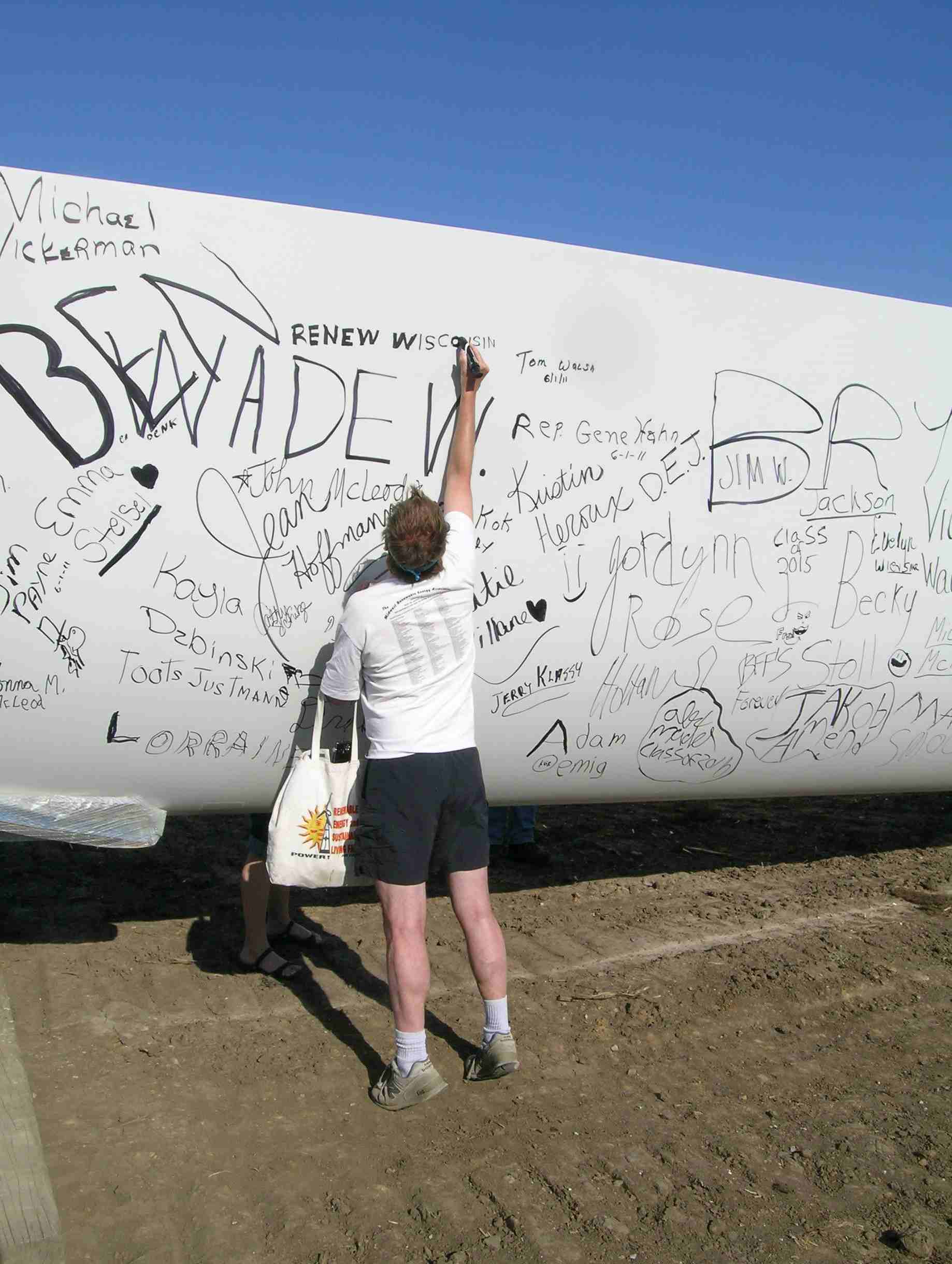
TOWN OF SCOTT - Along with names, dates and shout-outs to favorite sports teams, the writing on the turbine blade included a warning: "Watch out."

Mark Barden wrote it, in permanent black marker.

The warning, he said, is aimed at any birds that might fly near the blade once it's turning, 400 feet in the air.

Wednesday's open house at the Glacier Hills Wind Park was Barden's first up-close look at the components of the 90 electricity-generating wind turbines that have begun to rise in the skyline in northeast Columbia County.

But it won't be his last look. Barden said three of the towers will be on his land in the town of Scott, just outside of Cambria.

He said he doesn't share the health and safety concerns about the wind towers that many of their opponents cited in seeking to block the construction of Glacier Hills - things such as constant low-level noise and shadow flicker.

"I'm more worried," he said, "about the red lights at night," he said. "When I look in the sky and try to find constellations, all I'll see is the red beacons (on the towers).

"But," Barden added, "we'll deal with that."

Barden was one of several hundred people who attended the open house, which included indoor easel and tabletop displays, and a tour - on foot or by school bus - of one of the four towers that, as of Wednesday, had two of its four segments erected.

Mike Strader, site manager for the We Energies project, said that, barring wind or other inclement weather, plans call for adding the top two segments to at least one of the towers today, with the hub, cell and three blades of the turbine to follow soon.

More photos on RENEW's Facebook page.

Energy groups oppose bill to undermine Wisconsin's renewable energy commitment

Thursday, May 26, 2011

From statements issued by three groups in opposition to Assembly Bill 146:

"Clearly, this bill is a drastic step in the wrong direction for our state. The Wisconsin Energy Business Association therefore opposes this attack on renewable energy in our state." - Wisconsin Energy Business Association. Full statement.

We strongly recommend that this bill not be approved as it solves no known problem in Wisconsin and seeks only to roll-back policies on renewable energy that have served the state well and are otherwise benefitting Wisconsin residents with cleaner air and lower prices for electricity. - Wind on the Wires. Full statement.

Fresh attack on Wisconsin voters’ desire for a renewable energy standard would kill wind projects and sap state’s economy, say wind energy advocates - American Wind Energy Association. Full statement.

State clean energy mandates have little effect on electricity rates so far

Tuesday, May 17, 2011

From an article by Don Huagen in Midwest Energy News:

One of the larger reviews of renewable portfolio standards was a 2008 report (PDF) from the Lawrence Berkeley National Laboratory. The study looked at data on a dozen state renewable policies enacted before 2007. The estimated impact on electricity rates varied by state, but it was a fraction of a percent in most cases and just over 1 percent in two states, Connecticut and Massachusetts. “There is little evidence of a sizable impact on average retail electricity rates so far,” the report concluded.

One of the report’s co-authors, Galen Barbose, said in an interview that they are collecting data for an updated version of the report. So far he said he hasn’t seen any new information to suggest their conclusion about rate impacts will change significantly in the next edition.

A 2009 study by the U.S. Energy Information Administration modeled the potential impact of a 25 percent nationwide renewable electricity standard. It, too, noted that rate impacts would vary by state, with renewable-rich regions like the Great Plains and Northwest meeting the targets more easily. Overall, though, it projected no impact on rates through 2020, followed by a less than 3 percent increase by 2025. By 2030, however, it projected little difference in rates with or without a national renewable mandate.

The Minnesota Free Market Institute and American Tradition Institute reached a very different conclusion in an April 2011 report (PDF), which claims Minnesota’s renewable electricity standard is going to cause rates in the state to skyrocket by as much as 37 percent by 2025.

Utilities’ experiences vary
Xcel Energy, the state’s largest utility, has come up with a much smaller number: $0.003. That’s the difference Xcel forecasts between its projected per-kilowatt-hour energy price in 2025 under its proposed wind expansion plan compared to a hypothetical scenario in which it stopped adding new wind capacity after 2012.

Asked to comment on the Free Market Institute’s study, Xcel Energy spokesman Steve Roalstad said, “It doesn’t seem to be moving in that direction.” The cost of adding renewable energy sources, especially wind, continues to fall and has become very competitive with traditional generating sources, he said.

Poll finds strong support for wind energy in Wisconsin

Wednesday, April 27, 2011

From an article in the Chicago Tribune:

MADISON, Wis.— A poll of Wisconsin residents finds strong support for increasing the use of wind energy, even if doing so would raise electricity bills several dollars per month.

The Wisconsin Public Radio poll was released Friday. It shows that 77 percent of respondents want to see the state invest more in wind energy. Reasons included decreasing the nation's reliance on foreign oil and helping the environment.

A majority, 69 percent, wouldn't mind eight to 10 wind-energy machines being placed closed to where they live, and 79 percent favor placing the machines offshore in Lake Michigan.

Click here for poll results.