Showing posts with label Economic development. Show all posts

Train Manufacturer Sues Wisconsin Over Default on Train Contract

Monday, November 05, 2012

From a news release issued by Talgo:

On November 1, 2012, the Walker administration forced Talgo, Inc., to terminate its contract with the State of Wisconsin to build passenger trains to be used by the State for Amtrak’s Hiawatha line between Milwaukee and Chicago. Talgo has substantially completed the trains under its contract, but the State has arbitrarily decided not to put the trains in service and has refused to pay Talgo the millions of dollars that it still owes for them. Talgo has filed a lawsuit in Dane County against Governor Scott Walker and Secretary of Transportation Mark Gottlieb, asking the court to review the State’s course of conduct, determine that the State defaulted on the contract, and rule that Talgo properly terminated it.

As a result of the Walker administration’s actions, once the court rules in favor of Talgo, the State of Wisconsin will have no further rights under the contract and will lose the almost $50 million it has already spent on the project. This amount includes only part of the contracted price for the trains, the State’s payments to consultants and its investment in a Milwaukee facility for temporary maintenance work.

Business group asks senator to end "unsubstantiated attacks on wind"

Tuesday, July 17, 2012

From a news release issued by the Wisconsin Energy Business Association:

Wisconsin Businesses Call on Sen. Lasee to End His War on Wind 
Unsubstantiated attacks on wind industry are preventing economic growth across Wisconsin 

In another attempt to hinder wind development and economic growth in Wisconsin, state Senator Frank Lasee (R-De Pere) is demanding that the Public Service Commission of Wisconsin revisit the state’s uniform wind siting rule, PSC 128—a rule that is the product of years of work by the Commission, a citizen advisory council, and industry experts. His most recent attacks are based on the demonstrably false claim that wind energy facilities cause adverse health impacts.

“Senator Lasee’s ongoing hostility towards Wisconsin’s wind industry is preventing real economic growth,” said Chris Kunkle of the Wisconsin Energy Business Association. “National companies looking to invest in Wisconsin’s economy see these unwarranted and baseless attacks and continue to stay out of Wisconsin.”

Medical professionals are unwavering in their repeated analysis that there is no discernible correlation between wind energy generation and negative health impacts. This was stated most recently in a report to the Massachusetts Dept. of Public Health that definitively concluded there is “no foundation for a set of symptoms that is called Wind Turbine Syndrome” and was also recently affirmed by Wisconsin’s Department of Health Services (DHS). . . .

State urged to beef up clean energy policies to create jobs

Wednesday, October 26, 2011

From an article by Judy Newman in the Wisconsin State Journal:

Two reports show Wisconsin has a significant renewable power industry, but with a stronger state commitment, it could be saving more energy and creating more jobs.

Wisconsin has more than 300 businesses involved in wind or solar energy, providing more than 12,000 jobs, according to a study by the Environmental Law and Policy Center in Chicago.

It found 171 Wisconsin companies that either produce, sell or install wind power equipment or plan wind development.

Another 135 companies are part of the solar energy industry. For example, Cardinal Glass makes solar panels in Mazomanie; Helios recently opened a solar panel factory in Milwaukee.

"These are real jobs; these are real businesses. Many are existing businesses that are branching out into new product lines," said Howard Learner, the center's executive director.

Other Midwestern states get federal funds for trains

Friday, August 05, 2011

From an article by Candace Lombardi on Cnet News:

Department of Transportation Secretary Ray LaHood on Wednesday announced his office is dispersing an additional $336.2 million in funds toward the massive U.S. high-speed rail public works project underway.

This time, the money is going for the trains themselves.

Including this latest release, $782 million has been dispersed for purchasing 33 locomotives and 120 bi-level train cars for California, Illinois, Iowa, Michigan, Missouri, and Washington.

The federal government has now allocated a total of $10.1 billion, set aside via the American Reinvestment and Recovery Act of 2009, for the introduction of high-speed rail as well as updates and extensions for urban and commuter rail systems throughout the U.S.

To ensure that the money stays in the U.S. and directly produces jobs, LaHood has made contracts open to foreign as well as domestic companies, but only on the condition that they employ U.S. workers and locate or expand their manufacture facilities within the U.S. to carry out the contracts, according to the Department of Transportation.

The massive public works project has been met with enthusiasm from the majority of U.S. states, happy to get federal funding that could have an immediate impact on jobs during a very dismal economic downturn. More than 39 states and the District of Columbia have submitted requests for funding for various legs of the high-speed railway.

Wisconsin turns inhospitable to green businesses

Thursday, July 21, 2011

From an article by Nathan J. Comp in The Isthmus:

A new report from the Brookings Institution sizing up the health of the nation's green economy shows Wisconsin ranks 13th in the number of green jobs, with Madison ranking fifth among cities.

Problem is that many of these jobs will likely disappear as a result of recent policy rollbacks and funding cuts that critics say have already begun to decimate the state's clean energy infrastructure.

"There is a concerted effort to drive out clean energy jobs," says state Rep. Brett Hulsey (D-Middleton). "Companies specializing in renewable energy are getting creamed right now."

Since taking office in January, Gov. Scott Walker's administration and the GOP-controlled Legislature have, among other things, suspended the wind turbine siting rule, cut millions of dollars from a statewide program that helps bring down costs of energy efficiency and renewable energy projects for companies and local governments, and enacted a law allowing utility companies to satisfy renewable energy requirements by importing hydroelectric power from Canada.

A pending bill would allow utilities to bank renewable energy credits in perpetuity, which would effectively extend the 2015 deadline for adding new sources of renewable energy indefinitely.

Walker's spokesman didn't respond to requests for comment.

Michael Vickerman of RENEW Wisconsin, a nonprofit devoted to clean energy strategies, says the industry's mood "varies from contractor to contractor, but it's pretty grim. We're the only state to drive out its renewable energy businesses."

Vickerman says that many companies have contracts that will sustain them through the end of the year, but with funding and policy support drying up, many will be forced to close their doors.

"We're going to document situations where there are layoffs or where companies relocate to states where their prospects are unchanged," he says. "Walker should be congratulated by governors of other states for pushing business into their greener pastures."

Trains unnecessarily cost Wisconsin taxpayers millions due to Walker's fund rejection

Wednesday, July 20, 2011

From an article by Larry Sandler and Jason Stein:

Wisconsin taxpayers could wind up paying more to keep existing passenger train service from Milwaukee to Chicago than they would have paid to run new high-speed rail service from Milwaukee to Madison, according to a Journal Sentinel analysis of state figures.

The Legislature's budget committee voted 12-2 Tuesday to spend $31.6 million in mostly borrowed state money on Amtrak's Milwaukee-to-Chicago Hiawatha line, costs that could have been paid largely by an $810 million federal grant that would have extended the Hiawatha to Madison.

But Tuesday's vote doesn't cover all the spending that will be needed to keep running the Hiawatha, a growing service that carried nearly 800,000 passengers last year.

State transportation officials have estimated they would need millions more for locomotives, signals and a new maintenance base, even without expanding service beyond the current seven daily round trips.

And, like the spending approved Tuesday, all or most of those new costs would have been covered by the federal grant spurned by Gov. Scott Walker last year. That's because the Milwaukee-to-Madison service would have operated as an extension of the Hiawatha, as part of a larger plan to connect Chicago to the Twin Cities and other Midwestern destinations with fast, frequent trains.

Taken together, state taxpayers' share of the Hiawatha capital costs that would have been covered by the federal grant could total as much as $99 million, significantly more than the $30 million they would have paid for 20 years of operating costs on the Milwaukee-to-Madison segment, as estimated by former Democratic Gov. Jim Doyle's administration.

Walker had cited those operating costs as his main reason for opposing the 110-mph extension. Federal money would have paid all of its capital costs. And that doesn't count the other potential benefits that high-speed rail supporters have cited from the Milwaukee-to-Madison line, such as jobs, economic development, expanded tax base and improved freight rail tracks.

National Study Vindicates Wisconsin’s Clean Energy Policies

Monday, July 18, 2011

Immediate release
July 18, 2011

More information
Michael Vickerman
Executive Director
608.255.4044
mvickerman@renewwisconsin.org

National Study Vindicates Wisconsin’s Clean Energy Policies

Nearly a decade of forward-looking strategies propelled investments in Wisconsin’s clean jobs economy above other Midwest states, according to an economic study issued by The Brookings Institution, a nonpartisan public policy organization in Washington, D.C.

Reviewing data gathered between 2003 and 2010, the Brookings analysis pegged the number of clean economy jobs in the state at 76,858, a net increase of nearly 4,000. Measured as a percentage, Wisconsin’s clean economy accounted for 2.7% of all jobs in the state, compared with 2.5% for Iowa, 2.1% for Minnesota, 1.9 % for both Indiana and Michigan, and 1.8% for Illinois. Overall, Wisconsin ranked 8th among all states and the District of Columbia in the relative size of its clean economy.

The report categorizes clean economy jobs as those in energy efficiency and renewable energy; sustainable forestry products; recycling and reuse; waste management and treatment; organic food and farming; energy efficient appliance and building manufacturing; and more.

“Clearly, Wisconsin’s commitment to clean energy has paid dividends, attracting new businesses and creating high-paying jobs that could have easily gone elsewhere,” said Michael Vickerman, executive director of RENEW Wisconsin, a statewide organization advocating for public policies and private initiatives that advance renewable energy.

These policies and initiatives include the establishment of Focus on Energy, the region’s first ratepayer-funded energy efficiency and renewable energy program, attractive buyback rates offered by utilities for renewable energy, and innovative incentives to encourage customer installation of renewables.

In addition, Wisconsin’s adoption of a 10% renewable energy standard back in 2006 spurred new utility-scale installations built by skilled tradesmen employed by local contractors. During the study period, the number of wind-related jobs in Wisconsin doubled from less than 450 to 900.

As documented in the Brookings report, the wages for these clean economy jobs run higher than the statewide average ($37,931 vs. $35,906).

“Unfortunately, Wisconsin’s clean economy is in danger of losing a good deal of its steam as a result of policy rollbacks and funding cutbacks in the renewable energy arena,” Vickerman said. “The short-sighted attacks we’ve seen in 2011 could throw the state’s clean economy into reverse next year.”

So far this year, the Legislature has reduced funding for Focus on Energy, suspended the statewide rule regulating the permitting of wind turbines, and weakened the state’s renewable energy standard by allowing utilities to count Canadian hydropower toward their requirements.

“On top of that, We Energies, the state’s largest utility, announced that it will discontinue what had been an effective renewable energy initiative,” Vickerman said. “Among other accomplishments, it was instrumental in enabling Helios USA to build a solar-electric manufacturing facility in Milwaukee’s Menomonee River Valley.” The plant now employs 50 workers.

END

RENEW Wisconsin is an independent, nonprofit 501(c)(3) organization that acts as a catalyst to advance a sustainable energy future through public policy and private sector initiatives. More information on RENEW’s Web site at www.renewwisconsin.org.

Good news: Walker creates clean energy jobs, Bad news: They are in Canada

Tuesday, July 12, 2011

A news release issued by Rep. Brett Hulsey (D-Madison):

Madison, WI— In another blow to jobs and clean energy efforts in Wisconsin, Republican Governor Scott Walker signed the “Clean Energy Jobs for Canada Act” SB 81 this week that allows a Wisconsin utility to import renewable energy from Canada rather than invest in Wisconsin jobs and clean energy.

“Sadly Governor Walker and the GOP outsource our energy jobs to other countries while Wisconsin citizens will have fewer jobs and higher energy costs,” said Rep. Brett Hulsey (D-Madison), member of the Assembly Energy and Utilities Committee.

A Canadian Broadcast Corporation headline read:

“Hydro deal to generate thousands of jobs

A $2-billion deal to export hydroelectric power to Wisconsin will require thousands of workers on several generating stations and transmission lines in Manitoba…”

“Walker and the GOP cut clean energy jobs here and outsource them to foreign countries. Democrats will continue to fight to keep jobs and produce clean energy in the state,” said Rep. Hulsey.

Walker and the GOP recently repealed a Public Service Commission requirement that would increase Wisconsin’s energy efficiency and renewable resources after GOP PSC Chair Phil Montgomery issued a press release touting the benefits of the Focus on Energy clean energy program saving Wisconsinites $380 million in 2010 alone. Walker and the GOP also want to create some of the strictest wind energy rules in the nation threatening more than 1,000 wind energy jobs, according to Renew Wisconsin, http://www.renewwisconsin.org.

Wisconsin’s Widening War on Renewable Energy

Monday, July 11, 2011

Dramatic Slowdown in Market Activity Anticipated
By Michael Vickerman
July 11, 2011

What started out as an opening salvo from the Walker Administration to shackle large-scale wind projects has in six months turned into a systematic campaign to dismantle the state policies that support renewable energy development. Joining the executive and legislative branches in pursuing policy rollbacks and/or funding cutbacks against renewables are various utilities and, surprisingly, Focus on Energy, Wisconsin’s ratepayer-funded energy efficiency and renewable programs.

Since January 1st, Wisconsin has seen a series of assaults against utility-scale projects and smaller renewable systems serving both residences and businesses. These include the following actions:
  • The Legislature suspended PSC 128, the statewide rule developed by the Public Service Commission last year in response to a law passed by the Legislature in 2009 ordering the agency to establish uniform standards for permitting wind energy systems. Since the March 1 suspension vote, wind development in Wisconsin has slowed to a standstill.
  • The Legislature adopted SB 81, a bill that RENEW Wisconsin describes as the “Outsource Renewable Energy to Canada Act.” SB 81 allows Wisconsin utilities to meet their renewable energy requirements beginning in 2015 with electricity generated from large hydropower plants in other states and Canada. By allowing Wisconsin utilities to become even more dependent on energy imports than they are today, SB 81 turns Wisconsin’s Renewable Energy Standard on its head. Importing large-scale hydropower exports the very dollars that could have been used to harness Wisconsin’s renewable energy resources. 
  • We Energies, the state’s largest electric utility, abruptly decided in May to walk away from an agreement with RENEW to dedicate $60 million over a 10-year period in support of renewable energy development in its territory. The decision came in the sixth year of this program. We Energies plans to reallocate the unspent dollars (totaling about $27 million) to general operations. 
  • Green Bay-based Wisconsin Public Service (WPS) instituted in April a new net energy policy designed to discourage new customer-sited renewable energy systems. Until recently WPS had been paying its customers the full retail rate for electricity that flows back on the wires, which is now about 12 cents/kWh. But under the new rate, WPS only pays three cents/kWh for electricity exported to the grid. Moreover, the utility calculates the net each month, which penalizes customers whose loads vary significantly depending on seasonal factors. Right now, the new policy only covers systems installed after March 2011, but WPS has said that it plans to apply that rate to older systems effective January 2013.
  • In its deliberations on the biennial state budget passed in June, the Legislature appended a rider to tie Focus on Energy’s annual budget to a percentage (1.2% of gross utility revenues). This action will mean a cut of $20 million in the program’s 2012 budget relative to this year’s allocation of $120 million. The Focus on Energy program provides grants and cash-back awards supporting customer investments in solar electric, solar thermal systems, small wind, biogas and biomass energy systems. 
  • Last, but certainly not least, as of July 1, Focus on Energy stopped accepting applications for business program incentives to help customers install renewable energy systems. These incentives, which average about $7 million per year, had been available since 2002 to businesses, farms, schools, local governments and other nonprofit customers. It is not clear when these incentives will be resumed and in what quantity. 

Small businesses hit hard by cuts and changes in Focus on Energy

Wednesday, June 29, 2011

From an article by Judy Newman in the Wisconsin State Journal:

Focus on Energy, a statewide program that promotes energy efficiency, is in the midst of big changes: new management by an out-of-state corporation, suspension of a popular rebate program, and sharp funding cuts in the pending state budget.

Nearly 20 people already have lost their jobs, mostly in Madison, as a result of the management change.

Meanwhile, dozens of small Wisconsin businesses that specialize in setting up solar panels and wind turbines fear for their futures because of the slashed allocation and rebate removal.

“It’s a lot of economic activity and jobs in Wisconsin. It’s a lot of energy efficiency, as well,” said Keith Reopelle, policy director for Clean Wisconsin.

Focus on Energy was created in 2001 to provide education, resources and cash incentives to Wisconsin residents and businesses to increase the use of energy-efficient products and systems, from furnaces to solar panels to vending machines.

In the past 10 years, more than 91,000 businesses and more than 1.7 million residents used the program and saved $2.20 for every dollar spent, according to Focus data. . . .

Since taking over Focus on Energy on May 9, one of Shaw’s first decisions, with PSC support, was to suspend payments to businesses that install renewable-energy systems, as of June 30.

Contractors like Seventh Generation Energy Systems were stunned.“It’s pretty devastating,” said James Yockey, chief executive officer. “It probably took out six to 10 projects that we were looking to close ... for work in the fall and the coming spring.”

Several of the projects were wind turbines for farmers. “I think the incentives are decisive in people saying yes,” Yockey said . . . .

Program supporters have appealed to Gov. Scott Walker to veto the Focus budget cut, including a letter signed by 124 Wisconsin businesses. As of Friday, there was no word on his response. Walker is scheduled to sign the budget today.

“Cutting Focus on Energy will result in higher electricity bills and fewer jobs,” Randy Johnson, president of U.S. Lamp, a Green Bay energy-efficient lighting design company, said in the letter.

Seventh Generation’s Yockey said he hopes to avoid laying off any of his 16 employees by aiming his business at other states, and that could mean moving the company. “We prefer to be located in Madison but the bottom line is: we’ll see where the business takes us,” he said.

Madison wind installer wins national award

Tuesday, June 28, 2011

Immediate release: June 28, 2011
More info: Jim Yockey 608-770-9660

Wisconsin business wins National Small Wind Installer of the year

MADISON – Seventh Generation Systems Integration was awarded the National Installer of the Year honor at the 7th Annual Small Wind Conference in Stevens Point, WI on June 16th. This recognition of national scope is given to the company for their positive contribution to the growth of the distributed wind industry.


According to the American Wind Energy Association, small wind turbine installations grew 15% in 2009. Wisconsin is well suited for small wind, defined as turbines of 100 kilowatts or less, because of the rural landscape and economy. Until recently, state incentives helped grow the small wind industry through Focus on Energy, supported by a strong presence in the Midwest Renewable Energy Association.

The small wind industry has seen its share of challenges since Seventh Generation began in 2002. As an emerging industry, small wind manufacturers are always keeping up with industry standards and customers’ needs. The honor of receiving the Small Wind Installer of the Year comes as a result of working exceptionally well with manufacturers and state programs to serve the needs of rural Wisconsin.

Currently, Seventh Generation has installed more than 30 small wind turbines ranging in size from 10kW to 100kW, for a collective installed capacity of more than 1megwatt. Seventh Generation works primarily with farms, camps, schools, and businesses to match technology to the customer’s energy requirements. Along with the engineering and design of renewable energy systems, the company is recognized as a leader in resource monitoring and analysis. More about the organization can be found at www.sges.us.

END

State’s Hostility Toward Renewables Escalates; “Leaders” Lag Citizenry on Wind Support

Monday, June 27, 2011

Two articles from Catching Wind, a newsletter published by RENEW Wisconsin with funding from a grant from the U.S. Department of Energy:

State’s Hostility Toward Renewables Escalates
At the urging of Wisconsin utilities, several lawmakers have introduced a bill to allow a renewable energy credit (REC) to be banked indefinitely. If adopted, this measure (AB146) would constitute the most devastating legislative assault yet on the state’s renewable energy marketplace, which is already reeling from the suspension of the statewide wind siting rule this March and the loosening of renewable energy definitions to allow Wisconsin utilities to count electricity generated from large Canadian hydro projects toward their renewable energy requirements.

“Leaders” Lag Citizenry on Wind Support
Public support for wind energy development has held strong against the attacks launched by Governor Walker and the Legislature’s new Republican majority, according to a poll conducted between April 11 and April 18 by the St. Norbert College Survey Center for Wisconsin Public Radio.

Asked whether Wisconsin should "increase, decrease or continue with the same amount" of energy supply from various sources, 77% favored increasing wind power, the highest of any option (60% favored increasing hydropower, 54% biomass, 39% natural gas, 27% nuclear, and 19% coal).

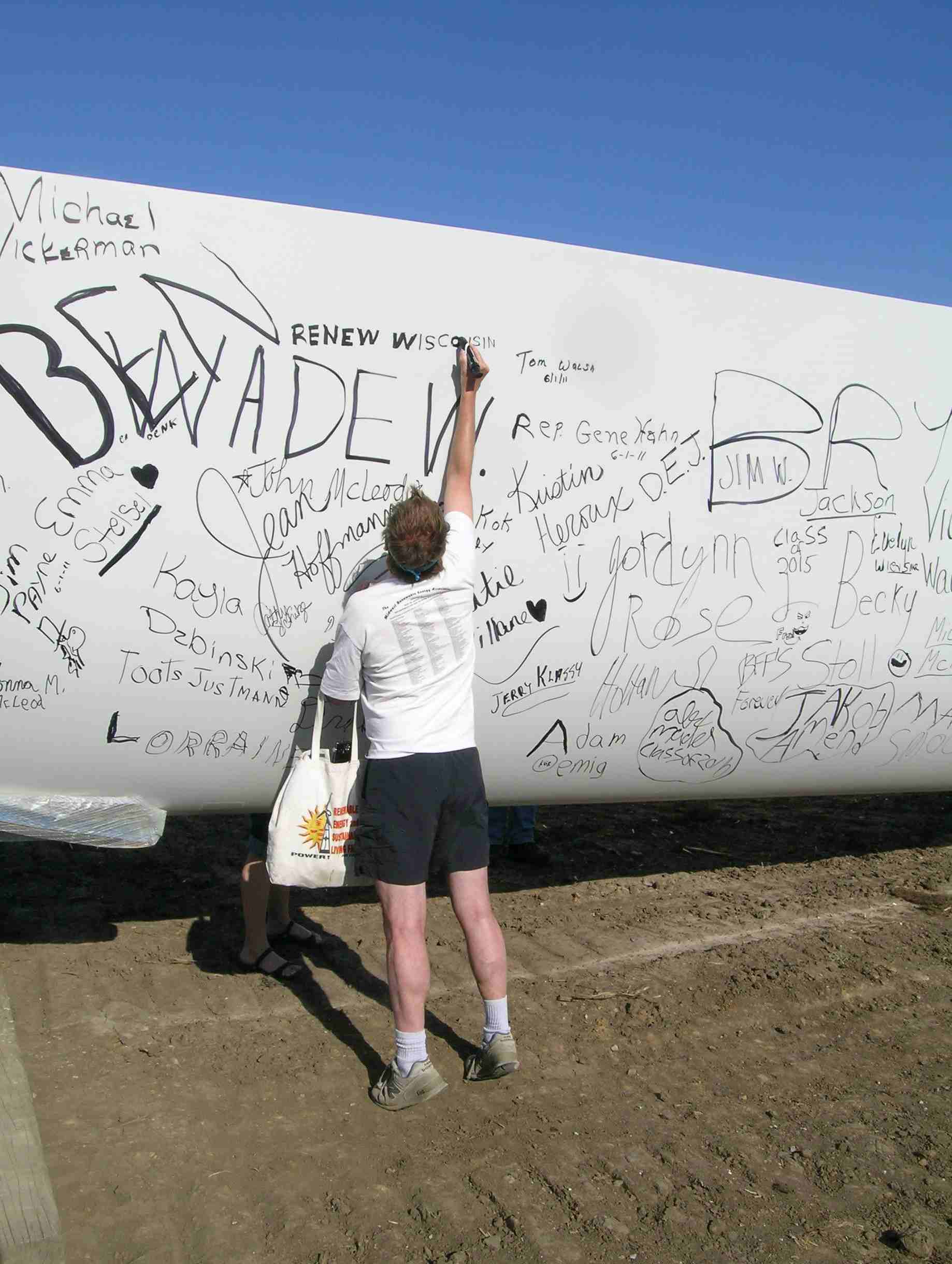
Written on the wind: Glacier Hills open house offers up-close look at project

Thursday, June 02, 2011


From an article by Lyn Jerde in the Portage Daily Register:

TOWN OF SCOTT - Along with names, dates and shout-outs to favorite sports teams, the writing on the turbine blade included a warning: "Watch out."

Mark Barden wrote it, in permanent black marker.

The warning, he said, is aimed at any birds that might fly near the blade once it's turning, 400 feet in the air.

Wednesday's open house at the Glacier Hills Wind Park was Barden's first up-close look at the components of the 90 electricity-generating wind turbines that have begun to rise in the skyline in northeast Columbia County.

But it won't be his last look. Barden said three of the towers will be on his land in the town of Scott, just outside of Cambria.

He said he doesn't share the health and safety concerns about the wind towers that many of their opponents cited in seeking to block the construction of Glacier Hills - things such as constant low-level noise and shadow flicker.

"I'm more worried," he said, "about the red lights at night," he said. "When I look in the sky and try to find constellations, all I'll see is the red beacons (on the towers).

"But," Barden added, "we'll deal with that."

Barden was one of several hundred people who attended the open house, which included indoor easel and tabletop displays, and a tour - on foot or by school bus - of one of the four towers that, as of Wednesday, had two of its four segments erected.

Mike Strader, site manager for the We Energies project, said that, barring wind or other inclement weather, plans call for adding the top two segments to at least one of the towers today, with the hub, cell and three blades of the turbine to follow soon.

More photos on RENEW's Facebook page.

Without aid, Hiawatha is in a pinch

Monday, May 16, 2011

From an article by Larry Sandler in the Milwaukee Journal Sentinel:

Wisconsin scrambles to replace federal money

After being turned down for federal high-speed rail funds, state officials are now pondering how to pay for millions of dollars of work needed to keep the existing Amtrak service running between Milwaukee and Chicago.

Last week, the federal government rejected the state's request for more than $150 million for new locomotives, passenger cars and a maintenance base to upgrade the Hiawatha line. Also rejected was a bid for nearly $60 million in related track, signal and engineering work.

That decision followed Gov. Scott Walker's refusal to build a 110-mph extension of the Hiawatha to Madison, as part of a larger plan to connect Chicago to the Twin Cities and other Midwestern destinations. After Walker's election, the federal government pulled nearly all of the $810 million stimulus grant that would have paid for the long-planned Milwaukee-to-Madison stretch.

But Walker supported keeping and upgrading the existing Milwaukee-to-Chicago service, with backing from the Milwaukee-area business community. And since some of the $810 million would have been used to improve existing service, the state asked for $213.3 million for that purpose.

Now, after the federal rejection, the state is faced with at least $209.1 million in potential costs for the existing service. But only $69.5 million in state and federal funds has been committed to those expenses, leaving a gap of $139.6 million.

Some of that gap could be filled by borrowing. From 1993 to 2009, lawmakers approved $122 million in borrowing power for passenger rail projects. To date, state officials have used $49.5 million of that authority, leaving $72.5 million available.

Transportation officials have asked the Legislature's Joint Finance Committee for permission to use some of that bonding power. But even if they could use all of it, they would still come up more than $67 million short.

We Energies terminates its renewable energy program

Friday, May 13, 2011

For immediate release
May 13, 2011

More information
RENEW Wisconsin
Michael Vickerman
608.255.4044
mvickerman@renewwisconsin.org

We Energies Terminates Its Renewable Energy Program
Utility Pulls Plug on $6 Million a Year Commitment

As reported on its Web site, Milwaukee-based We Energies will discontinue an innovative and effective renewable energy development program that supported scores of renewable energy systems throughout its service territory. [The announcement can be accessed at http://www.we-energies.com/re.]

“It’s a sad day when the state’s largest utility decides to walk away from its commitment to a clean energy future,” said Michael Vickerman, executive director of RENEW Wisconsin, a statewide organization advocating for public policies and private initiatives that advance renewable energy.

As indicated in various filings with the Public Service Commission, We Energies had committed to spend $6 million a year over 10 years to increase its renewable energy supplies and make renewable energy more affordable to its customers through grants and incentives. We Energies’ commitment came in the wake of a settlement with RENEW over the utility’s plans to build two coal-fired power stations in southeast Wisconsin.

Of the $60 million committed, the utility has spent approximately $30 million since 2006. This program will be zeroed out in We Energies’ next rate filing, which will cover 2012 and 2013.
This program supported numerous customer-sited renewable energy installations [see list below], conferences and workshops, research and development activities, and innovative buyback rates.

“Perhaps not coincidently, the decision to terminate this program comes just months after We Energies placed its second coal-fired plant in service. The $6 million a year was a small price to pay for the all of the renewable energy advances that occurred while the utility built two coal plants,” said Vickerman.

“Now that the coal plant is up and running, it appears that the program has outlived its usefulness to We Energies,” Vickerman said.

Six million dollars equates to about .025 percent of We Energies’ annual expenditures.

“This cancellation comes as a blow to area contractors and businesses that were relying on the program to create jobs and clean energy,” said Vickerman. “The achievements leveraged far outweigh the program’s negligible cost.”

“Between utility program cutbacks and state government rollbacks, Wisconsin’s policy framework for supporting renewable energy will be largely dismantled by the end of the year.”

New report drives home the benefits of high-speed rail

Monday, May 02, 2011

From a column by Dave Zweifel in The Capital Times:

With a guy like Scott Walker as governor, it’s probably tilting at windmills, but once again a comprehensive report has called attention to the importance of modernizing the Midwest’s rail system.

Late last week a group of transportation advocates and legislators released a report titled “The Economic Impacts of High-Speed Rail: Transforming the Midwest,” which showed that expanding passenger rail service in Wisconsin and the Midwest could create more than 100,000 jobs and $13.8 billion of economic activity.

During a press conference in the Capitol, the group noted that after the governor turned down $810 million in federal stimulus funds to improve passenger rail between Chicago and Milwaukee and extend it to Madison, he now is seeking federal help to upgrade the rail beds and add a train set on the Chicago-Milwaukee route. . . .

Despite the size of the Midwest’s economy, the report noted, it doesn’t have the transportation infrastructure to compete in today’s global marketplace.

Walker could have made sure Wisconsin was part of a new network that one day will transform the nation’s reliance on automobiles and the uncertainty of air travel.

His shortsightedness will cost us dearly for a long time to come.

Rising Diesel Prices Fuel Higher Electric Rates

Friday, April 15, 2011

For immediate release
April 15, 2011

More information
RENEW Wisconsin
Michael Vickerman
608.255.4044
mvickerman@renewwisconsin.org

We Energies Customers Will Pay the Higher Cost of Hauling Coal

We Energies’ electricity customers can look forward to coughing up an additional $25 million in 2011 due to the Public Service Commission’s approval yesterday [April14] of a rate increase to cover the escalating cost of transporting coal to Wisconsin power plants.

Milwaukee-based We Energies, Wisconsin’s largest electric utility, imports coal from such distant locations as Wyoming and Pennsylvania to generate electricity. Transportation now accounts for two-thirds of the delivered cost of coal to Wisconsin.

Diesel fuel costs have jumped to approximately $4.00 a gallon this year, propelled by political unrest in the Middle East, declining petroleum output from Mexico, a weakening dollar, and other factors. We Energies’ request predated the ongoing civil war in Libya.

“While we cannot control any of those price drivers, we can more effectively cushion their effects by diversifying our energy generation mix with locally produced wind, solar, small hydro, and biogas electricity,” said Michael Vickerman, executive director of RENEW Wisconsin, a statewide organization advocating for public policies and private initiatives that advance renewable energy.

“The coal mines aren’t getting any closer to Wisconsin. Therefore we have to be serious about reducing our dependence on fossil fuels that are tied to the global oil supply picture. Now is not the time to skimp on investments in conservation and renewable energy that will help stabilize the utility bills of businesses and residents,” Vickerman said.

“Do we have the will to pursue energy policies that take us off of the fossil fuel price escalator? Doing nothing will bake these rate increases into our future without any corresponding boost to Wisconsin’s job market and sustainable energy economy.”
--END--

Walker should reconsider his stance on setbacks for wind farms

Friday, April 08, 2011

From an editorial in the Milwaukee Journal Sentinel:

Wind farms in Wisconsin can lessen the state's reliance on coal-fired power plants at the same time that they add jobs to the economy. But instead of moving forward on this economic development tool, Gov. Scott Walker's administration is taking a step back. That's a mistake and something Walker should rethink.

What the governor and the Legislature have done is change the rules under which wind farms are sited, seeking to put greater distance between homes and wind farms. As a result, at least two firms have announced they are canceling or suspending plans to build wind farms in Wisconsin - and that means a loss of potential jobs.

Here's what happened: Two years ago, the Legislature called on the state Public Service Commission to establish a uniform standard for wind projects across the state. The idea was that a statewide standard was better than the patchwork of local rules and moratoriums that were in place. It was a good idea, and the PSC came up with a rule.

One of its elements was a 1,250-foot setback from a neighbor's property line; it also would have provided decibel and shadow flicker requirements for wind farm turbines.

The setback wasn't enough for Walker and wind farm opponents; in January, the governor introduced a bill with a 1,800-foot setback, although he said this week that his administration remains open to wind energy. Last week, a legislative committee sent the PSC's new rule back to the PSC for more work. The concern is that wind farms will hurt property values of neighboring residents.

That's resulted in enough uncertainty over the future of wind farms in Wisconsin that Invenergy of Chicago canceled plans to develop a wind farm near Green Bay and Midwest Wind Energy suspended development of two wind farms.

A statewide standard still needs to be set by the PSC. And the legitimate concerns of neighbors of wind farms need to be taken into account without giving too much credence to fears that are unfounded and overstated. But the standard should not be so restrictive that wind farms become impractical in Wisconsin. That takes Wisconsin out of the clean energy economy - a bad bet.

Open letter from former supporter rips anti-wind group

Tuesday, April 05, 2011

A Fox Valley person provided a copy of the following letter to RENEW Wisconsin:

People of Glenmore Township:
PLEASE VOTE RESPONSIBLY!

Dear Fellow Townspeople,

Two months ago, I was a supporter of the BCCRWE [Brown County Citizens for Responsible Wind Energy]. I was actively opposing the wind turbines coming into any of the townships in our area, including Glenmore.

But then something happened.

As the March 7th meeting drew closer, I heard disturbing things from members of the BCCRWE. Things that scared me. Even before the meeting took place, there were threats being made towards our town board members if the vote did not go in the favor of the BCCRWE. There were “agendas” being planned, and conspiracies being formed, not only against the project, but against individual people.

On March 7th, I sat quietly through the meeting listening to barbaric accusations, foul language, curses and threats hurled at our town board. Members of the BCCRWE shouted inappropriate and belittling comments and became unruly and disruptive to the point that law enforcement needed to be called. Later, I read accounts of that same meeting, written by the BCCRWE, that were horribly distorted and inaccurate. Actually, they were straight out lies!

On March 16th, I sat through another meeting and watched the same unruly group, once again, disrespect our town leaders. As the members of the BCCRWE were chanting “Shame on you” to the town board, I was the one that was ashamed to have ever been a part of that group.

On April 5th, you have an opportunity to elect new town board members. Many of the candidates are the same people who threatened and disrespected our current board members for following the law. One candidate admitted, her only goal was to terminate wind turbines in the town and then she wants out. Is that the chairperson you want running the entire township? Even for one term?

The recent events of oil spills in the gulf and nuclear plant failures in Japan should make all of us take a second look at wind energy. I realized after the two meetings in March, that the only reason I didn’t want turbines, was because I couldn’t have on of my own. So, I’m a NIMBY.

It’s important, that we have “responsible” leaders in our township. The mob I witnessed at the last two meetings, did not fit that definition. It would be a disaster to have those people who demonstrated irrational, biased and disorderly behavior, become our new leaders. I was embarrassed to have ever been a part of that group.

Since I have seen how threatening and dangerous this group can be, I prefer to sign only as,

A Concerned Townsperson

Legislators ask Walker to apply for rail funds

Tuesday, March 29, 2011

March 29, 2011
Governor Scott Walker
115 East, State Capitol
Madison, WI 53703

Dear Governor Walker:
We all want to create jobs and reduce the tax burden on Wisconsin citizens. We are writing to urge you to consider applying for $2.4 billion in high speed train money that is now available to restore train service to our Capital and Wisconsin. There are many reasons to do this.

This federal money will save Wisconsin state taxpayers from having to upgrade our freight lines and stretch the $60 million for rail upgrades in your capital budget.

As you know, this measure will help create at least 5,500 jobs as well as save the jobs at the Talgo Train Assembly Plant in Milwaukee.

Other states around us are competing for these federal funds. Our state Capital is also one of the only Capitals in the Midwest that does not have train service. In order to compete for high wage jobs, we need a high tech transportation system.

Also, you know that Wisconsin taxpayers pay more into the federal coffers than we receive back and applying for this money could help get our fair share of federal resources.

I hope you will support making Wisconsin “Open for Business” by expanding transportation choices and train infrastructure.

For more information, go to http://www.fra.dot.gov/roa/press_releases/fp_DOT%2029-11.shtml.

Thank you for your consideration.

Sincerely,
Rep. Brett Hulsey
Rep. Amy Sue Vruwink
Rep. Kelda Roys
Rep. Chris Sinicki
Rep. Jon Richards
Rep. Fred Kessler
Rep. Terese Berceau
Rep. Sandy Pasch
Rep. Mark Pocan
Rep. JoCasta Zamarripa
Rep. Fred Clark

Sen. Mark Miller
Sen. Chris Larson
Sen. Dave Hansen