Small businesses hit hard by cuts and changes in Focus on Energy

Wednesday, June 29, 2011

From an article by Judy Newman in the Wisconsin State Journal:

Focus on Energy, a statewide program that promotes energy efficiency, is in the midst of big changes: new management by an out-of-state corporation, suspension of a popular rebate program, and sharp funding cuts in the pending state budget.

Nearly 20 people already have lost their jobs, mostly in Madison, as a result of the management change.

Meanwhile, dozens of small Wisconsin businesses that specialize in setting up solar panels and wind turbines fear for their futures because of the slashed allocation and rebate removal.

“It’s a lot of economic activity and jobs in Wisconsin. It’s a lot of energy efficiency, as well,” said Keith Reopelle, policy director for Clean Wisconsin.

Focus on Energy was created in 2001 to provide education, resources and cash incentives to Wisconsin residents and businesses to increase the use of energy-efficient products and systems, from furnaces to solar panels to vending machines.

In the past 10 years, more than 91,000 businesses and more than 1.7 million residents used the program and saved $2.20 for every dollar spent, according to Focus data. . . .

Since taking over Focus on Energy on May 9, one of Shaw’s first decisions, with PSC support, was to suspend payments to businesses that install renewable-energy systems, as of June 30.

Contractors like Seventh Generation Energy Systems were stunned.“It’s pretty devastating,” said James Yockey, chief executive officer. “It probably took out six to 10 projects that we were looking to close ... for work in the fall and the coming spring.”

Several of the projects were wind turbines for farmers. “I think the incentives are decisive in people saying yes,” Yockey said . . . .

Program supporters have appealed to Gov. Scott Walker to veto the Focus budget cut, including a letter signed by 124 Wisconsin businesses. As of Friday, there was no word on his response. Walker is scheduled to sign the budget today.

“Cutting Focus on Energy will result in higher electricity bills and fewer jobs,” Randy Johnson, president of U.S. Lamp, a Green Bay energy-efficient lighting design company, said in the letter.

Seventh Generation’s Yockey said he hopes to avoid laying off any of his 16 employees by aiming his business at other states, and that could mean moving the company. “We prefer to be located in Madison but the bottom line is: we’ll see where the business takes us,” he said.

Madison wind installer wins national award

Tuesday, June 28, 2011

Immediate release: June 28, 2011
More info: Jim Yockey 608-770-9660

Wisconsin business wins National Small Wind Installer of the year

MADISON – Seventh Generation Systems Integration was awarded the National Installer of the Year honor at the 7th Annual Small Wind Conference in Stevens Point, WI on June 16th. This recognition of national scope is given to the company for their positive contribution to the growth of the distributed wind industry.


According to the American Wind Energy Association, small wind turbine installations grew 15% in 2009. Wisconsin is well suited for small wind, defined as turbines of 100 kilowatts or less, because of the rural landscape and economy. Until recently, state incentives helped grow the small wind industry through Focus on Energy, supported by a strong presence in the Midwest Renewable Energy Association.

The small wind industry has seen its share of challenges since Seventh Generation began in 2002. As an emerging industry, small wind manufacturers are always keeping up with industry standards and customers’ needs. The honor of receiving the Small Wind Installer of the Year comes as a result of working exceptionally well with manufacturers and state programs to serve the needs of rural Wisconsin.

Currently, Seventh Generation has installed more than 30 small wind turbines ranging in size from 10kW to 100kW, for a collective installed capacity of more than 1megwatt. Seventh Generation works primarily with farms, camps, schools, and businesses to match technology to the customer’s energy requirements. Along with the engineering and design of renewable energy systems, the company is recognized as a leader in resource monitoring and analysis. More about the organization can be found at www.sges.us.

END

State’s Hostility Toward Renewables Escalates; “Leaders” Lag Citizenry on Wind Support

Monday, June 27, 2011

Two articles from Catching Wind, a newsletter published by RENEW Wisconsin with funding from a grant from the U.S. Department of Energy:

State’s Hostility Toward Renewables Escalates
At the urging of Wisconsin utilities, several lawmakers have introduced a bill to allow a renewable energy credit (REC) to be banked indefinitely. If adopted, this measure (AB146) would constitute the most devastating legislative assault yet on the state’s renewable energy marketplace, which is already reeling from the suspension of the statewide wind siting rule this March and the loosening of renewable energy definitions to allow Wisconsin utilities to count electricity generated from large Canadian hydro projects toward their renewable energy requirements.

“Leaders” Lag Citizenry on Wind Support
Public support for wind energy development has held strong against the attacks launched by Governor Walker and the Legislature’s new Republican majority, according to a poll conducted between April 11 and April 18 by the St. Norbert College Survey Center for Wisconsin Public Radio.

Asked whether Wisconsin should "increase, decrease or continue with the same amount" of energy supply from various sources, 77% favored increasing wind power, the highest of any option (60% favored increasing hydropower, 54% biomass, 39% natural gas, 27% nuclear, and 19% coal).

120 businesses urge funding support for job creation through energy efficiency and renewable energy

Friday, June 24, 2011


From an article by Charles Davis in the Green Bay Press Gazette:

Thousands of future jobs are at stake if Gov. Scott Walker doesn't veto a provision in the state budget that limits funding for the Focus on Energy program, local business leaders said Wednesday.

"I see it being a real detriment to our business and our customers going forward if we don't have these funding increases," said Jeff Klonowski, regional manager of Kaukauna-based Energy Federation Inc., which supplies lighting fixtures, foam and weather-stripping materials to area contractors.

But supporters of the provision object to the amount of the funding increase, not the program.

"The Focus on Energy program certainly had a lot of benefits, but the huge increase in assessments that were put in place at the end of last year, we think, were too much, too soon," said Scott Manley, director of environmental and energy policy for Wisconsin Manufacturers and Commerce, the state's largest business lobby.

Walker received a letter Wednesday signed by more than 120 businesses asking that he veto that provision in the state budget bill. His office responded with a one-line statement: "We'll evaluate that provision and make any veto-related announcements once the decisions have been finalized."

The program
The statewide Focus on Energy program is funded by tax assessments on utility bills and provides grants to help homeowners and businesses pay for energy-efficient upgrades. It also helps pay for consultants to advise property owners on which type of upgrades would be practical and cost-effective. Each year, utility companies contribute 1.2 percent of revenue — about $100 million total — to the program.

The state Public Service Commission proposed in December raising the utility bill assessments from $94 million in 2010 to $256 million by 2014.

The proposal calls for utilities to increase their contributions to $120 million this year. That amount is fixed even if Walker does not veto the provision. However, assessments would drop to around $100 million in 2012, instead of the initial proposed increase of $160 million for that year.

Image by Clean Wisconsin

Energy program cuts called short-sighted

Thursday, June 23, 2011

From an article by Mike Ivey in The Capital Times:

Stanley Minnick runs a one-man consulting company in Madison called Third Power Energy Solutions.

Minnick founded the company earlier this year with the primary aim of helping businesses, non-profits and residents save money on their energy bills.

But just as Minnick is getting his business up and running, the state has cut funding for Focus on Energy, which provides grants to help pay for conservation efforts like solar power installations or high-efficiency lighting.

"The timing on all of this is just awful," says Minnick. "We're supposed to be growing the state economy and help new business get going. It just doesn't make any sense."

The new state budget cuts funding for the state Focus on Energy from $120 million to less than $100 million annually. It also rolls back annual increases approved in December 2010 by former Gov. Jim Doyle's Public Service Commission that would have upped funding to $256 million by 2014.

The monies come from a 1.2 percent tax on electric utility sales -- an arrangement the investor-owned utilties have begrudingly accepted though hardly embraced.

Minnick says those grants, which go to utility customers who make energy improvements, have provided stability to the conservation industry and helped businesses make investments they might not have pursued otherwise.

The cuts were approved last month by the Joint Finance Committee and included in the budget signed by Gov. Scott Walker last week.

"It's unfortunate this ended up mixed into the budget because I don't think a lot of Legislators had time to really look at it," says Keith Reopelle, senior policy director at Clean Wisconsin.

Clean energy advocates note that Wisconsin sends $17 billion of state annually to purchase coal, oil and natural gas. They say that every $1 invested in Focus on Energy reduces energy bills for consumers by at least $2.50. They also credit the program with creating 24,000 jobs in the state.

Southeastern Wisconsin leaders ask state to restore mass transit funding

Tuesday, June 14, 2011

From an article in BizTimes Daily:

A coalition of southeastern Wisconsin civic, educational and business leaders is asking the state Legislature to restore state funding for mass transit in the region.

The coalition sent a letter to state senators and Assembly members Monday, calling on legislators to refrain from making the cuts outlined in Gov. Scott Walker’s budget repair bill. The letter said mass transit is vital to the economic future of southeastern Wisconsin economy.

The letter was co-signed by Kenosha Mayor Keith Bosman; Cudahy Mayor Anthony Day; St. Francis Mayor Al Richards; South Milwaukee Mayor Tom Zepecki; Racine Mayor John Dickert; Oak Creek Mayor Richard Bolander; Milwaukee County Executive Chris Abele; Greater Milwaukee Committee President Julia Taylor; Racine Area Chamber of Commerce President Michael Kobylka; South Suburban Chamber of Commerce President Barbara Wesener; KenoshaArea Business Alliance President Todd Battle; University of Wisconsin-Milwaukee Chancellor Michael Lovell; University of Wisconsin-Parkside Chancellor Deborah Ford; Milwaukee Downtown Executive Director Beth Nicols; Devin Sutherland of Downtown Racine Corp. BID #1; Mike Fabishak of Associated General Contractors Greater Milwaukee; and Tom Rave of The Gateway to Milwaukee.

The letter stated:
“In the current economy, creating, maintaining, and connecting people to private sector jobs is a top priority. The state budget proposal to drastically reduce state funding for already severely strained transit systems in SE Wisconsin would threaten economic growth by making it harder or impossible for workers to get to jobs and discourage employers from locating or expanding in Wisconsin. . . .

Walker says ‘yes’ to roads we don’t need

Wednesday, June 08, 2011

From a column by Dave Zweifel in The Capital Times:

Whether it’s a result of recent bad winters or just the impact of more and more traffic, local roads and streets have taken a serious beating throughout Wisconsin.

Potholes, sunken manhole covers and deteriorating concrete and asphalt are taking their toll on cars and the nerves of the people who ride in them. Many communities and counties have fallen behind on road maintenance in recent years because of budget shortfalls.

But we’ll just have to learn to live with the disintegrating roads and streets thanks to yet another curious set of priorities on the part of the Scott Walker administration.

The new Wisconsin budget, which is headed full speed to implementation, includes massive cuts to Wisconsin schools, fewer dollars for the working poor, more tax breaks for big business and, yes, less money to help the state’s already-beleaguered municipalities fix streets and roads. (Madison is on the verge of losing $1 million.)

Instead, the budget that’s being fashioned by the Walkerite-dominated Joint Committee on Finance will effectively shift transportation dollars away from the locals and into the hands of the big road builders who gave so generously to get Walker elected.

While local road aid is headed for what looks like a $35 million cut, some $328 million more is being earmarked for new highway construction by shifting automobile sales tax revenue, which has historically gone to the general fund, into the transportation budget. Further, more dollars for big highways are being freed up by shifting public transit out of the transportation budget and into the general fund, where public transportation will be more vulnerable to indiscriminate budget cutting.

Peak Oil Meeting, June 9

Tuesday, June 07, 2011

Please join us for the Madison Peak Oil Group (MPOG) monthly brown bag meeting this Thursday! (It was delayed one week this month.)

Time: 12:00 noon on Thursday, June 9th
Place: 222 South Hamilton Street, Madison
RENEW conference room on the lower level

Please renew your annual MPOG membership if you have not done so yet. Suggested level $15 – more if you can afford it. Make out your check to Madison Peak Oil Group and give it to Ed Blume in person…or mail to him at 222 South Hamilton Street, Madison WI 53703

Agenda:
(1) Introductions
(2) Financial Report
(3) Announcements, Upcoming Events

June 17-19: Midwest Renewable Energy Association Fair
https://www.midwestrenew.org/energyfair

June 24: Statewide Transit Advocates meeting
Best Western Inn on the Park, Madison
Exact time to be announced: most likely mid-day or afternoon
Contact Kerry Thomas to get on mailing list: kthomas@transitnow.org (262) 246-6151

July 8-10: EcoFair 360, Walworth County Fairgrounds
http://ef2011.ecovisionslc.org/hours
MPOG will present – WE NEED A VOLUNTEER

July 28: Wisconsin Association of Railroad Passengers summit, Wisconsin Dells
Contact Mike McCoy to get on mailing list: mccoymh@chorus.net
MPOG members are hereby encouraged to join ProRail/WisARP
http://www.prorail.com/about.html (Sorry but the website is kinda flakey)
Membership = $20/yr. Make out your check to ProRail and send to:
ProRail Membership, P.O. Box 5401, Madison, WI 53705-0401

(4) Reports, Summaries

June 1-4: Congress for the New Urbanism
http://www.cnu.org/node/3697

(5) State Government Issues

Status of Renewable Energy – Mike Vickerman

Status of RTA and Transit

(6) Electrified Steel Interstate – Alan Drake concept
I recommend we make this a top priority for MPOG
Please review this before meeting: http://www.theoildrum.com/node/4301?nocomments

Summary of EXCELLENT meeting on June 2nd

Now online: Wisconsin Renewable Quarterly

Monday, June 06, 2011

The Wisconsin Renewable Quarterly, the newsletter of RENEW Wisconsin, features these article:

Siting Rule Suspension Rocks Wind Industry
In a move that sent shock waves through the wind industry in Wisconsin, a joint legislative panel voted on March 1 to suspend the wind siting rule promulgated by the Public Service Commission in December 2010.

Community Biogas Project Fires Up
Home to 400 dairy farms, Dane County recently dedicated a community-scale manure-to-methane generating system designed to reduce nutrient runoff into the Yahara Lakes.

Insty Prints: Mpower ChaMpion
But if I can help other businesses make some of the harder choices by being more vocal, then I’m willing to help.

Manitoba Hydro: A Washout?
On behalf of our members and the many businesses and individuals who support the continued expansion of Wisconsin’s renewable energy marketplace, RENEW Wisconsin is here to express opposition to AB 114 (and its companion SB 81), and urges the Legislature not to pass this bill.

Verona Firm Begins Work on “Epic” PV
With the commissioning of its 1,300-module solar electric canopy spanning its parking deck, Epic Systems joins an elite group of Wisconsin companies embracing on-site energy capture to reduce their dependence on fossil fuels. At 360 kilowatts (kW), Epic’s new photovoltaic system is the largest solar array in Dane County and the third largest in Wisconsin.

Calendar of Renewable and Energy Efficiency Events
June 17-19, 2001 The Energy Fair. Custer, WI. The nation’s premier sustainable energy education event. Three days of workshops, demonstrations, and exhibits highlighting renewable energy and sustainable living. For details see www.midwestrenew.org.

July 8-10, 2011 EcoFair360. Elkhorn, WI. Join hundreds of exhibitors and presenters and thousands of attendees who will Make Green Happen for three days of education, exploration and inspiration. For details see www.ecofair360.org.

July 16, 2011 Western Wisconsin Sustainability Fair. Menomonie, WI, Dunn County Fair Grounds. Exhibitors from business, government, and non-profi t groups, speakers, workshops, music, energy effi cient vehicles, a photo contest, and a tour of the Cedar Falls Dam. See http://sustainabledunn.org for more information.

July 30, 2011 8th Annual Kickapoo Country Fair. LaFarge, WI. The Midwest’s Largest Organic Food and Sustainability Festival. Food, music, bike and farm tours, cooking demonstrations, theater, kids’ activities, dancing. More information at www.kickappoocountryfair.org.

October 1, 2011 Solar Tour of Homes and Businesses. All across Wisconsin. Owners open their doors to let people see how renewable energy is practical, reliable, and affordable in today’s economy. The homes and businesses often include other energy efficiency and renewable technologies. For details see http://nationalsolartour.org.

October 26, 2011 Wisconsin’s Solar Decade Conference. Milwaukee, WI. Now in its seventh year, the Wisconsin
Solar Decade Conference is your opportunity to see fi rsthand the latest developments in the world of solar energy. For details see www.solardecade.com.

Coal companies shape lessons in public schools

Friday, June 03, 2011

From an article by Kevin Sieff in The Washington Post:

In the mountains of southwestern Virginia, Gequetta Bright Laney taught public high school students this spring about a subject of keen interest to the region’s biggest employer: the economics of coal mining.

“Where there’s coal, there’s opportunity,” Bright Laney told her class at Coeburn High School in Wise County.

Her lessons, like others in dozens of public schools across the country, were approved and funded by the coal industry. Such efforts reflect a broader pattern of private-sector attempts to influence what gets taught in public schools.

Eager to burnish its reputation, the energy industry is spending significant sums of money on education in communities with sensitive coal, natural gas and oil exploration projects. The industry aims to teach students about its contributions to local economies and counter criticism from environmental groups.

These outreach efforts have drawn scrutiny after news in May that Scholastic, the world’s largest publisher of children’s books, distributed fourth-grade curriculum materials funded by the American Coal Foundation. The “United States of Energy” lesson plan, which the foundation paid $300,000 to develop, went to 66,000 fourth-grade teachers in 2009. After critics raised questions about potential bias, Scholastic announced that it will no longer publish the material in question.

Environmentalists and public education groups say the Scholastic example highlights the increasingly cozy relationship between industry groups and public schools. They also criticize what takes place in classrooms such as Bright Laney’s, where industries fund lessons that echo their interests.

“We’re talking about catering our public school curriculum to those who can pay for it,” said Josh Golin, program manager at the Campaign for a Commercial-Free Childhood, based in Boston. “It raises questions about the foundation of our public education system.”

Written on the wind: Glacier Hills open house offers up-close look at project

Thursday, June 02, 2011


From an article by Lyn Jerde in the Portage Daily Register:

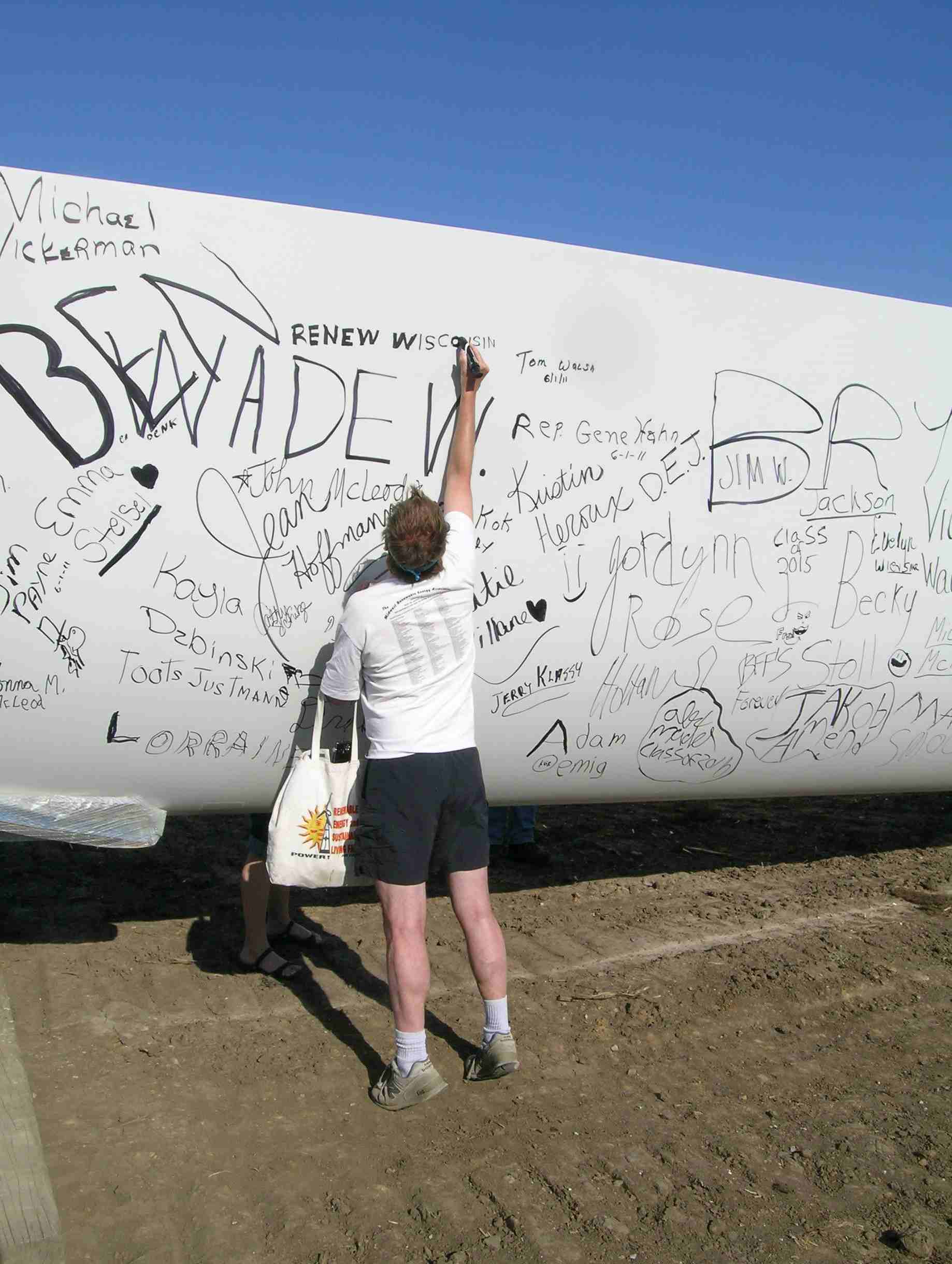
TOWN OF SCOTT - Along with names, dates and shout-outs to favorite sports teams, the writing on the turbine blade included a warning: "Watch out."

Mark Barden wrote it, in permanent black marker.

The warning, he said, is aimed at any birds that might fly near the blade once it's turning, 400 feet in the air.

Wednesday's open house at the Glacier Hills Wind Park was Barden's first up-close look at the components of the 90 electricity-generating wind turbines that have begun to rise in the skyline in northeast Columbia County.

But it won't be his last look. Barden said three of the towers will be on his land in the town of Scott, just outside of Cambria.

He said he doesn't share the health and safety concerns about the wind towers that many of their opponents cited in seeking to block the construction of Glacier Hills - things such as constant low-level noise and shadow flicker.

"I'm more worried," he said, "about the red lights at night," he said. "When I look in the sky and try to find constellations, all I'll see is the red beacons (on the towers).

"But," Barden added, "we'll deal with that."

Barden was one of several hundred people who attended the open house, which included indoor easel and tabletop displays, and a tour - on foot or by school bus - of one of the four towers that, as of Wednesday, had two of its four segments erected.

Mike Strader, site manager for the We Energies project, said that, barring wind or other inclement weather, plans call for adding the top two segments to at least one of the towers today, with the hub, cell and three blades of the turbine to follow soon.

More photos on RENEW's Facebook page.

Beyond the Bus-vs.-Rail Debate

Sunday, May 29, 2011

Beyond the Bus-vs.-Rail Debate: Cultivating Transit Discussions that Take Us Where We Need to Go

A talk by Jarrett Walker, international transit consultant and author of the weblog HumanTransit.org

Tuesday, May 31, 2011, 7:00 p.m.
UW Pyle Center, Room 313
702 Langdon St., Madison, WI

Like many cities, Madison has spent years debating rail and other ideas for improving area transit. Yet few of these proposals have moved forward, and new threats to transit funding could undo what progress has been made.

Why are debates over transit often so frustrating and contentious? Can we frame them differently to foster more productive conversations and stronger consensus, both about the kinds of transit systems we want and about the value and benefits of transit to our communities?

Jarrett Walker, international transit consultant and author of the popular transit policy weblog HumanTransit.org, thinks we can, and will discuss how in a talk on Tuesday evening, May 31, at 7:00 p.m. in Room 313 of the UW Pyle Center, 702 Langdon St. in Madison.

A fundamental problem, he maintains, is that heated quarrels over transit technologies have made it harder to think and talk clearly about what we really want for our communities and which choices best achieve those goals. The relationship between transit technology and transit outcomes is not always as clear as it seems, and categorical opinions about any technology, rail or bus, can blind us to many other ways to improve our transit systems and thereby enrich our communities and our lives. Approaching transit issues from a different point of view may make them easier to resolve.

Jarrett Walker, PhD, has been a consulting transit planner for 20 years, and has worked on a wide range of projects, from small-city bus re-structurings to major transit corridor studies. He has written HumanTransit.org since 2009 and his book Human Transit, expanding on themes from that writing, is forthcoming this fall from Island Press.

The talk is free and open to the public and is sponsored by the UW Center on Wisconsin Strategy’s State Smart Transportation Initiative, the Dane Alliance for Rational Transportation, the DaneTransit coalition, and the Madison Peak Oil Group. For further information contact Fred Bartol at (608) 251-6126.

Interactive Workshop on “Express Carpooling” - June 2, Madison

What: Presentation and Interactive Workshop on “Express Carpooling”

When: Thursday, June 2nd , 7:00-8:30 PM

Where: Room 202 of the downtown Madison Public Library

Here is a synopsis from Fred Bartol of DaneTransit:

What is “express carpooling” and how could it make getting around Madison and Dane County easier? Paul Minett, founder of Raspberry Express, an express carpooling initiative in Auckland, New Zealand, will describe what it is, how it works, and who might benefit from it.

Unlike formal ridesharing programs which match participants in advance for regularly scheduled car- or van-pooling arrangements, express carpooling enables riders and drivers, screened through a membership process, to meet at designated collection points for shared rides over established routes to designated drop-off points, then reverse the process later in the day. The route, rather than the ride, is what the service provider organizes based on commuter demand.

Minett believes the express model could make carpooling easier by making it more flexible and spontaneous, something commuters can use as needed, rather than having to arrange in advance and commit to for an extended period. The benefits could be significant, for commuters seeking to cut costs, for communities seeking to expand transportation options, and for regions seeking to manage traffic.

Born in the United Kingdom, Paul Minett was raised in Canada and has lived in New Zealand since 1987. An accountant and business consultant who holds an MBA from the University of Auckland, he is the co-inventor of a patented express carpooling system and has published and presented widely on the topic of carpooling and ridesharing. He has been a leader in founding the Ridesharing Institute, a research organization committed to expanding ridesharing practices worldwide, and will be in Madison to participate in the Congress for the New Urbanism conference, taking place June 1-4 at Monona Terrace.

The downtown Madison Public Library is located at 201 W. Mifflin St. in Madison. The presentation is free and open to the public and is sponsored by the Dane Alliance for Rational Transportation, the DaneTransit Coalition, and the Madison Peak Oil Group.

Electrified Steel Interstate - Planning meeting, June 2, Madison

Friday, May 27, 2011

What: Electrified Steel Interstate meeting (Alan Drake’s concept)
When: Thursday, June 2nd from 6:00 – 7:30 PM
Where: Sequoya Public Library, Meeting Room A, 4340 Tokay Blvd, Madison

The room has been reserved under the auspices of the Madison Peak Oil Group.

Overall goals of the meeting include:

(1) Develop and refine the Steel Interstate concept for Wisconsin (or perhaps the upper Midwest, given the central role of Chicago in the nation’s rail network)
(2) Identify key stakeholders
(3) Identify key advocacy partners
(4) Identify possibilities for collaboration (with the CFIRE group at UW Madison, for example – i.e. the National Center for Freight Infrastructure Research and Education.)
(5) Tally how much time/energy each of us is willing to contribute to this effort
(6) Come up with a reasonable action plan

I will send out a more detailed agenda by Sunday the 29th; if there are matters you want covered please let me know before then.

To prepare for the meeting, I would ask that you carefully read and make notes on Drake’s posting “Multiple Birds”.

What we need is something like a “peer review”: we want to make sure our logic is sound, our data is accurate, our goals are realistic, and our arguments are persuasive.

Sorry for the delay in scheduling this but I’m volunteering at CNU 19 this year and I needed to find out what my time slots were before I finalized this meeting.

Energy groups oppose bill to undermine Wisconsin's renewable energy commitment

Thursday, May 26, 2011

From statements issued by three groups in opposition to Assembly Bill 146:

"Clearly, this bill is a drastic step in the wrong direction for our state. The Wisconsin Energy Business Association therefore opposes this attack on renewable energy in our state." - Wisconsin Energy Business Association. Full statement.

We strongly recommend that this bill not be approved as it solves no known problem in Wisconsin and seeks only to roll-back policies on renewable energy that have served the state well and are otherwise benefitting Wisconsin residents with cleaner air and lower prices for electricity. - Wind on the Wires. Full statement.

Fresh attack on Wisconsin voters’ desire for a renewable energy standard would kill wind projects and sap state’s economy, say wind energy advocates - American Wind Energy Association. Full statement.

Chicago plans for heat wave -- a permanent one

Monday, May 23, 2011

From an article by Leslie Kaufman in The New York Times:

City planners in Chicago have been told that as temperatures rise, some plants native to the region will die out.

Climate scientists have told city planners that based on current trends, Chicago will feel more like Baton Rouge than a Northern metropolis before the end of this century.

So, Chicago is getting ready for a wetter, steamier future. Public alleyways are being repaved with materials that are permeable to water. The white oak, the state tree of Illinois, has been banned from city planting lists, and swamp oaks and sweet gum trees from the South have been given new priority. Thermal radar is being used to map the city’s hottest spots, which are then targets for pavement removal and the addition of vegetation to roofs. And air-conditioners are being considered for all 750 public schools, which until now have been heated but rarely cooled.

“Cities adapt or they go away,” said Aaron N. Durnbaugh, deputy commissioner of Chicago’s Department of Environment. “Climate change is happening in both real and dramatic ways, but also in slow, pervasive ways. We can handle it, but we do need to acknowledge it. We are on a 50-year cycle, but we need to get going.”

State clean energy mandates have little effect on electricity rates so far

Tuesday, May 17, 2011

From an article by Don Huagen in Midwest Energy News:

One of the larger reviews of renewable portfolio standards was a 2008 report (PDF) from the Lawrence Berkeley National Laboratory. The study looked at data on a dozen state renewable policies enacted before 2007. The estimated impact on electricity rates varied by state, but it was a fraction of a percent in most cases and just over 1 percent in two states, Connecticut and Massachusetts. “There is little evidence of a sizable impact on average retail electricity rates so far,” the report concluded.

One of the report’s co-authors, Galen Barbose, said in an interview that they are collecting data for an updated version of the report. So far he said he hasn’t seen any new information to suggest their conclusion about rate impacts will change significantly in the next edition.

A 2009 study by the U.S. Energy Information Administration modeled the potential impact of a 25 percent nationwide renewable electricity standard. It, too, noted that rate impacts would vary by state, with renewable-rich regions like the Great Plains and Northwest meeting the targets more easily. Overall, though, it projected no impact on rates through 2020, followed by a less than 3 percent increase by 2025. By 2030, however, it projected little difference in rates with or without a national renewable mandate.

The Minnesota Free Market Institute and American Tradition Institute reached a very different conclusion in an April 2011 report (PDF), which claims Minnesota’s renewable electricity standard is going to cause rates in the state to skyrocket by as much as 37 percent by 2025.

Utilities’ experiences vary
Xcel Energy, the state’s largest utility, has come up with a much smaller number: $0.003. That’s the difference Xcel forecasts between its projected per-kilowatt-hour energy price in 2025 under its proposed wind expansion plan compared to a hypothetical scenario in which it stopped adding new wind capacity after 2012.

Asked to comment on the Free Market Institute’s study, Xcel Energy spokesman Steve Roalstad said, “It doesn’t seem to be moving in that direction.” The cost of adding renewable energy sources, especially wind, continues to fall and has become very competitive with traditional generating sources, he said.

Without aid, Hiawatha is in a pinch

Monday, May 16, 2011

From an article by Larry Sandler in the Milwaukee Journal Sentinel:

Wisconsin scrambles to replace federal money

After being turned down for federal high-speed rail funds, state officials are now pondering how to pay for millions of dollars of work needed to keep the existing Amtrak service running between Milwaukee and Chicago.

Last week, the federal government rejected the state's request for more than $150 million for new locomotives, passenger cars and a maintenance base to upgrade the Hiawatha line. Also rejected was a bid for nearly $60 million in related track, signal and engineering work.

That decision followed Gov. Scott Walker's refusal to build a 110-mph extension of the Hiawatha to Madison, as part of a larger plan to connect Chicago to the Twin Cities and other Midwestern destinations. After Walker's election, the federal government pulled nearly all of the $810 million stimulus grant that would have paid for the long-planned Milwaukee-to-Madison stretch.

But Walker supported keeping and upgrading the existing Milwaukee-to-Chicago service, with backing from the Milwaukee-area business community. And since some of the $810 million would have been used to improve existing service, the state asked for $213.3 million for that purpose.

Now, after the federal rejection, the state is faced with at least $209.1 million in potential costs for the existing service. But only $69.5 million in state and federal funds has been committed to those expenses, leaving a gap of $139.6 million.

Some of that gap could be filled by borrowing. From 1993 to 2009, lawmakers approved $122 million in borrowing power for passenger rail projects. To date, state officials have used $49.5 million of that authority, leaving $72.5 million available.

Transportation officials have asked the Legislature's Joint Finance Committee for permission to use some of that bonding power. But even if they could use all of it, they would still come up more than $67 million short.

We Energies terminates its renewable energy program

Friday, May 13, 2011

For immediate release
May 13, 2011

More information
RENEW Wisconsin
Michael Vickerman
608.255.4044
mvickerman@renewwisconsin.org

We Energies Terminates Its Renewable Energy Program
Utility Pulls Plug on $6 Million a Year Commitment

As reported on its Web site, Milwaukee-based We Energies will discontinue an innovative and effective renewable energy development program that supported scores of renewable energy systems throughout its service territory. [The announcement can be accessed at http://www.we-energies.com/re.]

“It’s a sad day when the state’s largest utility decides to walk away from its commitment to a clean energy future,” said Michael Vickerman, executive director of RENEW Wisconsin, a statewide organization advocating for public policies and private initiatives that advance renewable energy.

As indicated in various filings with the Public Service Commission, We Energies had committed to spend $6 million a year over 10 years to increase its renewable energy supplies and make renewable energy more affordable to its customers through grants and incentives. We Energies’ commitment came in the wake of a settlement with RENEW over the utility’s plans to build two coal-fired power stations in southeast Wisconsin.

Of the $60 million committed, the utility has spent approximately $30 million since 2006. This program will be zeroed out in We Energies’ next rate filing, which will cover 2012 and 2013.
This program supported numerous customer-sited renewable energy installations [see list below], conferences and workshops, research and development activities, and innovative buyback rates.

“Perhaps not coincidently, the decision to terminate this program comes just months after We Energies placed its second coal-fired plant in service. The $6 million a year was a small price to pay for the all of the renewable energy advances that occurred while the utility built two coal plants,” said Vickerman.

“Now that the coal plant is up and running, it appears that the program has outlived its usefulness to We Energies,” Vickerman said.

Six million dollars equates to about .025 percent of We Energies’ annual expenditures.

“This cancellation comes as a blow to area contractors and businesses that were relying on the program to create jobs and clean energy,” said Vickerman. “The achievements leveraged far outweigh the program’s negligible cost.”

“Between utility program cutbacks and state government rollbacks, Wisconsin’s policy framework for supporting renewable energy will be largely dismantled by the end of the year.”

Rail money went to states with "farsighted leadership"

Tuesday, May 10, 2011

From an editorial in The New York Times:

None of the money in Monday’s announcement will be going to Wisconsin, for example, where Gov. Scott Walker has also decided that his strapped state could do without rail improvements and the construction jobs that go with them. Nor will it go to Ohio, where Gov. John Kasich preferred rejectionism to the improvement of rail service among the state’s largest cities, which could have produced 16,000 jobs.

Instead, it will go to 15 states that have more farsighted leadership, who understand the important role federal dollars can play in stimulating the economy, moving people quickly from place to place and reducing tailpipe emissions. Some of those states are led by Republicans: Gov. Rick Snyder of Michigan happily stood beside Transportation Secretary Ray LaHood on Monday to accept nearly $200 million to upgrade the rail line between Dearborn and Kalamazoo, the bulk of the Chicago-Detroit corridor.