Top Ten Sustainability Stories for 2006

Thursday, December 28, 2006

Green A City blog features blogger Warren Karlenzig's Top Ten Sustainability Stories for 2006:

The year of 2006 in review from the perspective of sustainability in state and local government, presented in order of importance.

Though we have been doing this blog only since May, so much has gone on since then that we are overwhelmed by the evidence that the nation is experiencing a collective tipping point.

1. Climate Change Policy Milestones
2. Boston Requires Green Construction for All Large Buildings
3. Portland to Institute Green Real Estate Multiple Listing Service (MLS)
4. New York's Sustainability Planning
5. Portland Biodiesel Requirement
6. Denver Greenprint
7. Record Summer Heat Wave
8. Plug-in Hybrid Vehicle Campaign
9. Oakland (CA) Local Food and Zero Fossil Fuel Goals
10. Best Practice Sustainability Knowledge Base Launched for Government


Since Warren lives in California, we'll forgive him for not including passage of Wisconsin's new Energy Efficiency and Renewables Law (Act 141).

I give Act 141 the #1 spot on Wisconsin's sustainability/renewable/energy efficiency scorecard for 2006.

Feel free to add your thoughts on Wisconsin's top accomplishments in 2006.

Technology in place for renewable energy industry

Tuesday, December 26, 2006

A story by Heidi Clausen in The Country Today includes projections that the U.S. can produce 25% of its energy needs by 2025:

ST. PAUL, MINN. - The American renewable energy industry may not have to reinvent the wheel to meet the national "25X'25" goal.

Technology already is in place, according to David Morris, vice president of the Institute for Local Self-Reliance.

"We need to bring what is at the fringes to the center," Mr. Morris said Dec. 12 at the Midwest Agriculture Energy Network Summit in St. Paul.


Continue reading Technology in place.

The Greening of Madison - January 23, 2007

Friday, December 22, 2006

Speakers:

Austin King, President of Madison City Council
Dan Dettman, City of Madison Engineering
Harry Sulzer, City of Madison New Construction Supervisor

Join us for a round table discussion about Madison’s Sustainable Future.

6:00 - 6:30pm Arrival

6:30 – 8:00pm Meeting

Host:
KJWW Engineering Consultants
302 W. Broadway, Suite 312
Madison, WI 53713

Snacks and beverages provided.

$10 fee – Make checks payable to IES-Madison section

RSVP by Jan. 14th

Contact: Ingrid McMasters at 608-221-6708 or mcmastersif@kjww.com

Holidays add $15-$50 to energy bills

Thursday, December 21, 2006

A story by Corinthia McCoy in the Green Bay Press-Gazette highlights the electricity and energy impact of the holidays:

With the holiday season comes the decoration fever so don't be surprised if you see holographic holiday scenes, inflatable scenes and characters and fiber-optic trees.

They're what's in, according to Wisconsin Public Service.

This year, WPS expects to tack on an additional $15 to $50 to the traditional electric bill with all those holiday decorations sucking the electricity.

For example, if you display eight sets of mini or icicle lights and three spotlights and leave them on for six hours, it will cost 52 cents a day, or $15.45 a month, according to the WPS Web site.

"We always do (see an increase) over the holiday season, but it's not only from the holiday lighting," said Karmen Lemke, community relations for WPS.

More washing, baking and houseguests occur during the holiday, adding to the bill, she said, not just those Christmas lights.

However, warmer temperatures may offset some of the cost, Lemke said.

In the meantime, to save energy WPS suggests plugging indoor and outdoor lighting displays into a timer pre-set to run for three to five hours, use light-emitting diode light strings, and enhance the lights on your tree with reflectors to avoid adding more to save energy.

Natural gas: Pipeline limits or limited supply?

Wednesday, December 20, 2006

An Associated Press story by Brad Foss looks at storage and pipeline shortages as the cause for higher than usual natural gas prices during the current mild winter.

However, Andrew Weissman (Editor-in-Chief & Publisher, EnergyBusinessWatch.com) finds an emerging natural gas crisis:

By the mid to later part of the next decade, this gap [betwen supply and demand] is likely to reach a minimum of 7.5 to 10.0 Tcf per year – an amount roughly equivalent, in BTU terms, to 1.5 X the amount of oil the U.S. currently imports from the Middle East.

Read Weissman's freightening predictions at energypulse.net.

WI AG joins opposition to Kansas coal-fired plants

Monday, December 18, 2006

A story by Scott Rothschild in the Lawrence (Kansas) Journal-World reports on a lawsuit against Sunflower Electric Power Corp.’s proposal to build three coal-fired plants in western Kansas:

Eight state attorneys general on Friday asked Kansas to reject Sunflower Electric Power Corp.’s proposal to build three coal-fired plants in western Kansas, saying carbon dioxide emissions from the project would contribute to destructive climate change.

“We encourage Kansas to explore alternatives that will allow Kansas to satisfy its needs for energy without exacerbating global warming,” the officials said in a letter to the Kansas Department of Health and Environment.

Steve Miller, a spokesman for Hays-based Sunflower Electric, said he disagreed with the position of the eight states, but that they were entitled to submit their remarks.

Miller said probably the best way to reduce carbon dioxide emissions would be to focus on improving pollution controls on plants in foreign countries.

The states opposed to Sunflower Electric’s proposal are California, Connecticut, Delaware, Maine, New York, Rhode Island, Vermont and Wisconsin. The Lawrence City Commission has also filed a letter in opposition.

Directory of Wisconsin alternative fuels stations

Thursday, December 14, 2006

A State of Wisconsin Web site offers listings of E85 and biodiesel retail outlets in the state: http://power.wisconsin.gov/biofuels.html.

Interactive map of alternative fuels stations

Wednesday, December 13, 2006

Cindy Jett of Mapmuse.com sent the following:

About 6 months ago, Mapmuse.com began a project- the interactive mapping of alternative fuel stations across the US. We initially researched and populated these maps ourselves, with the idea in mind that alternative fuel enthusiasts would subsequently add to, and enhance, the information we provided. We mapped each fuel station, and provided space for a written description, photo, and link to a website. We have maps for the following types of fuel stations: biodiesel; compressed natural gas; electric fueling; ethanol 85; hydrogen fuel; liquefied natural gas; propane fuel.

Since this project was started, the public has made hundreds of additions and enhancements to these maps. We now have one of the most comprehensive databases of alternative fuel stations in the US. If you were one of our contributors, we’d like to thank you for your help!

I’m writing today to ask that if you know of any alternative fuel stations that have opened or closed in the last 6 months, that you make those changes to the maps. Also, we encourage you to add any alternative fuel stations that we are still missing.

The link to the Going Green Directory of all of the alternative fuel stations maps is: http://find.mapmuse.com/interest/category/Going_Green

Inconvenient Truth and other movies for free

Monday, December 11, 2006

Chuck Learned posted the following on the Sustain Dane list serve:

I have not checked to see if all the links work.

An Inconvenient Truth is available free on youtube. here's a link:

http://www.youtube.com/watch?v=MwY4VU7zhsw&mode=related&search=

Also, I got emailed this today. It's a list of other "must see"
movies available on line:

David Attenborough's Climate Chaos

Part 1: http://www.dailymotion.com/video/640x480/xmq0n

Part 2: http://www.dailymotion.com/video/640x480/xmy11

Global Dimming

http://video.google.com/videoplay?docid=1027879546389218797

Strange Days on Planet Earth

2004 Trailer: http://www.dailymotion.com/video/640x480/xmj0l

Part 1: http://www.dailymotion.com/video/640x480/xmje7

Part 2: http://www.dailymotion.com/video/640x480/xmkei

Part 3: http://www.dailymotion.com/video/640x480/xmmvv

Part 4: http://www.dailymotion.com/video/640x480/xmolm

2007 Trailer: http://www.dailymotion.com/video/640x480/xmj1j

The Denial Machine

http://video.google.com/videoplay?docid=522784499045867811

The End of Suburbia

http://youtube.com/watch?v=Q3uvzcY2Xug

Trading Freedom: The Secret Life of The FTAA

http://www.dailymotion.com/video/640x480/xjcdl

Big Ideas That Changed The World

Part 1: http://www.dailymotion.com/video/640x480/xjb67

Part 2: http://www.dailymotion.com/video/640x480/xjbjg

Capitalism and Other Kid's Stuff

http://video.google.com/videoplay?docid=7115073581188191888

for a free world
Chuck
Chuck Learned
check out www.arboretumcohousing.org
sharing our lives balancing community and privacy

See how diesels run on vegetable oil, Dec. 8-10

Friday, December 08, 2006

Learn first-hand from a German Biofuels Engineer -- Workshop and Lectures at Madison's PrairieFire BioFuels Coop, December 8-10, at 1894 East Wash. Ave. This is a unique opportunity to learn about currently available biofuel technologies. See first hand how diesel vehicles are adapted to use straight vegetable oil (SVO) for fuel.

Alexander Noack, a BioFuels Engineer for Elsbett, is coming from Germany to PrairieFire BioFuels Coop. He will demonstrate SVO system installations on several diesel vehicles and give lectures during his visit. Visitors are welcome to take pictures and ask questions during system installations.

An ongoing workshop and open house will be held in the PrairieFire BioFuels Coop shop at 1894 East Washington Avenue in Madison, Wisconsin. They will be working Friday, Saturday, and Sunday Dec. 8-10, all day. At least three one-tank systems will be installed in passenger cars, and the recently introduced in the US two-tank system will be installed in a pickup truck.

Lectures will also be at the Coop shop (at 1894 East Washington Avenue in Madison, Wisconsin) on Friday December 8 from 5-6 pm and Saturday December 9 from 4-5 pm. Mr. Noack will discuss current biofuels issues in Europe and explain the technology behind the vegetable oil kits for diesel vehicles.

"A 1981 VW Dasher Diesel Turbo, which has run on SVO for 140,000 trouble free miles, will be on show-and-tell during workshop" says Dasher owner and coop member David Dudley.

The public is welcome to all events. This event is free to coop members. For nonmembers there is no cost for the open house and workshop, the lecture is $5 or free with the donation of a 5-gallon jug of used turkey frying oil.

PrairieFireBioFuels Coop is a member-owned cooperative creating access and building infrastructure to support vegetable-oil-based fuel sources and usage. PrairieFire is the only business selling biofuels on a main street of a capitol city in the United States, the only place in Wisconsin selling B100 biodiesel, and one of only four Elsbett Service Partners in the US.

Elsbett is best known in the US for their one-tank system, which enables diesel vehicles to run on pure plant oil (PPO), or straight vegetable oil (SVO) as it is more commonly known in the US. Elsbett has been developing SVO systems for diesel engines for nearly 30 years.

###


If you would like more information about this event, or about PrairieFire BioFuels Coop, contact Jeff Barnhart at the PrairieFire Office: 608-441-5454 or email info@prairiefirebiofuels.org

Arrowhead-Weston carrying power

Thursday, December 07, 2006

According to a story by D.J. Slater in the Wausau Daily Herald:

A surge of satisfaction struck officials at the American Transmission Co. after a second week of tests on its partially completed Arrowhead-Weston transmission line turned out successful.

American Transmission Co., a multi-state transmission utility corporation, recently finished a 143-mile segment that stretches from the Weston Power Plant in Rothschild to the Stone Lake Substation in Sawyer County. The line is designed to improve electrical reliability, reduce disturbances and increase electric import capability.

UWSP residence halls to use more renewable energy

Tuesday, December 05, 2006

A story from the Stevens Point Journal reports on renewable energy at the UW-Stevens Point:

The University of Wisconsin-Stevens Point Residence Hall Association (RHA) and Residential Living have each voted to buy 10 percent renewable energy from Wisconsin Public Service’s Nature Wise program for campus residence halls.

The 20 percent total increase will be in addition to the 10 percent campus-wide renewable energy provided through an SGA agreement signed earlier this year with WPS.

NatureWise provides energy derived from a blend of wind and biomass, which are gases produced naturally from landfills and farm animal waste. It allows customers to purchase 100-kilowatt-hour blocks of renewable energy each month for an additional one-dollar per block.

The official Nature Wise agreement will be signed Tuesday at 4 p.m. in Room 073 of the DeBot Center.

Cherokee Marsh homes need to be zero-energy consumers

Monday, December 04, 2006

In a personal letter to the City of Madison Plan Commission, Michael Vickerman offers his professional perspective on development plans for Cherokee Marsh:

First, I am pleased that an agreement was reached to scale back the physical footprint of this development. The City's commitment to acquire the most sensitive portions of this property is commendable.

However, the City's land purchase will have little impact on this project's energy impacts, which are considerable. As reported in the Wisconsin State Journal last week, the first phase of this development will consist of 60 to 70 upscale single-family houses. The default option is to heat these dwellings with natural gas, a premium energy source that is being rapidly depleted in North America. Presently about 80% of the natural gas consumed in the United States is supplied by domestic sources, and 15% comes from Canada, which exports half of its output to the U.S. (The remainder is imported from overseas.) According to the latest U.S. Geological Survey’s estimates, we have only 10 years of proven reserves at present consumption levels, while Canada’s Geological Survey estimates a mere eight years’ worth of reserves. Is this a good time to be adding a slew of larger houses that are dependent on this shrinking fuel? I think not. . . .

In my view the City of Madison has an obligation to all its citizens (and especially to those residences and businesses along the proposed 345 kV transmission line along the Beltline) to require new houses to capture a portion of the thermal and electric energy they use on-site. Given the considerable energy impacts from allowing the Cherokee Marsh development to go forward in a business-as-usual manner, the City ought to initiate such a policy there, before ground is broken.

Energy, Society and the Environment

Friday, December 01, 2006

You are invited to attend any of these three debates on controversial energy topics

“The Expansion of Subsidies for Wind Energy”
Tuesday, December 5, 2:30 - 3:45 p.m.
Room 175 Science Hall, 550 N. Park St., UW-Madison

“The Expansion of Nuclear Power”
Thursday, December 7, 2:30 - 3:45 p.m.
The State Capital - Room 413 North

“Corn to Ethanol”
Tuesday, December 12, 2:30 - 3:45 p.m.
Room 175 Science Hall, 550 N. Park St., UW-Madison

Sponsored by students registered in the Nelson Institute course.

For more information, please contact Richard Shaten at rjshaten@wisc.edu

The End of Ingenuity

Wednesday, November 29, 2006

The New York Times ran a lengthy commentary by Thomas Homer-Dixon on November 29. Thomas Homer-Dixon, director of the Trudeau Center for Peace and Conflict Studies at the University of Toronto, is the author of “The Upside of Down: Catastrophe, Creativity and the Renewal of Civilization.”

The commentary may be one of the first to appear on the Op Ed page of a major newspaper and speculate about the end of growth.

Two excerpts follow and the full commentary is here.

. . . The debate about limits to growth is coming back with a vengeance. The world’s supply of cheap energy is tightening, and humankind’s enormous output of greenhouse gases is disrupting the earth’s climate. Together, these two constraints could eventually hobble global economic growth and cap the size of the global economy. . . .

. . . we really need to start thinking hard about how our societies — especially those that are already very rich — can maintain their social and political stability, and satisfy the aspirations of their citizens, when we can no longer count on endless economic growth.

DNR ruling on pipeline expected this week

Monday, November 27, 2006

RENEW Wisconsin previously requested preparation of a full ecnomic impact statement (EIS) on the proposed Enbridge pipeline simply because the sand tars of Canada are not likely to support the pipeline for more than a few years.

A story by Andrew Hellpap in the Marshfield New Herald reports that the DNR may decide this week on whether to order an EIS:

State Department of Natural Resources officials are expected to rule early this week on a proposed petroleum pipeline from Superior to Delavan.

Phase one of Enbridge Inc.'s 321-mile pipeline would cross through the northeast corner of Clark County and diagonally from the northwest corner to the southeast corner of Wood County, intersecting lakes, rivers, forests and wetlands on private and public lands.

The public comment period on a series of DNR permits for construction of the pipeline has ended. About 30 individuals and several environmental groups raised questions about the permits and the environmental impact of the pipeline, said Jeff Schimpff, project manager for the DNR Office of Energy in Madison.

Wednesday, November 22, 2006

Unstoppable biker Hans Noeldner provided a link to some amusing and insightful quotes about bicycles and automobiles, including these:

"The bicycle is the most civilized conveyance known to man. Other forms of transport grow daily more nightmarish. Only the bicycle remains pure in heart."
~Iris Murdoch, writer (1919-1999)

”The automobile has not merely taken over the street, it has dissolved the living tissue of the city. Its appetite for space is absolutely insatiable; moving and parked, it devours urban land, leaving the buildings as mere islands of habitable space in a sea of dangerous and ugly traffic.”
~James Marston Fitch, New York Times, 1 May 1960

”Our national flower is the concrete cloverleaf.”
~Lewis Mumford

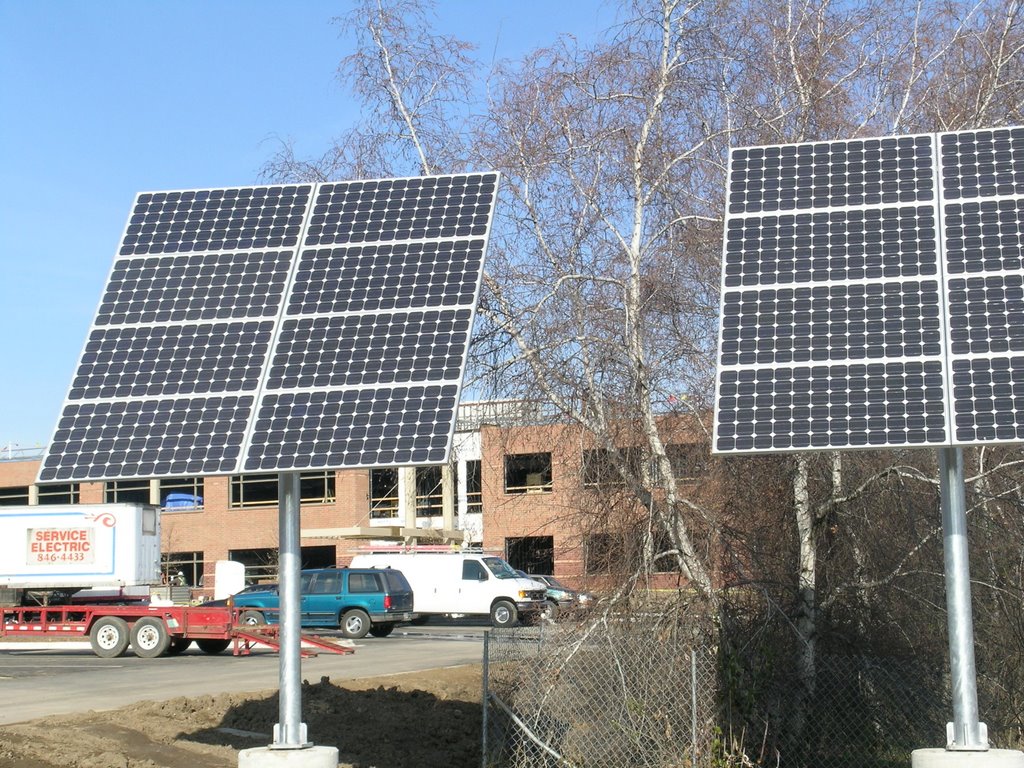
New WECC offices include solar

Tuesday, November 21, 2006


The solar panels above will add electricity to the new Madison offices of the Wisconsin Energy Conservation Corporation (WECC), administrator of Focus on Energy programs.

Along with other panels not shown, the installations have a rated capacity of more than 19 kW, making them collectively one of the largest installations in the state, second only to an installation on the campus of the UW-Green Bay.

Maybe Amtrak's time has arrived

Monday, November 20, 2006

Dave Zweifel speculates on the future of Amtrack in a Capital Times commentary:
"I have always wondered why the Amtrak debate is so emotional and at times acrimonious. It really needn't be, especially now. At a time of high oil prices, growing highway and airport congestion and record rail freight volumes, we should be embracing rail and developing it as quickly and as responsibly as we can.

"We should get beyond the debate of a few hundred million dollars of operating costs and begin to realize (what) the potential rail passenger service has to offer with the right level of investment and a clearly defined federal policy."

That's just a piece of the refreshing testimony that Amtrak's new president, Alex Kummant, gave to the House Railroads Subcommittee shortly after taking over the job in September.

Renewable energy cleans up in mid-term elections

Friday, November 17, 2006

RENEW's executive director Michael Vickerman offers a perspective on November's elections:

The gale-force winds that reshaped the political landscape this November augur well for new initiatives to substitute fossil fuel use with renewable energy.

To a degree unmatched in previous elections, candidates articulated an energy agenda that emphasized greater reliance on bioenergy, wind, solar, and conservation—and won, often by convincing margins. The renewable energy tide swept through not only both chambers of Congress but also many statehouses across the country. Only the Southeastern states seemed to escape its impact.


Read the full commentary here.